ISRO: A Personal History

The Indian Space Research Organisation, or ISRO, is one the most widely respected and revered organizations in the country. It has no doubt placed India on the map of Space research, with the many successful PSLVs, and the hugely popular Chandrayaan and Mangalyaan.
Of course, as any success story goes, there are humble beginnings that lead up to all the fanfare.

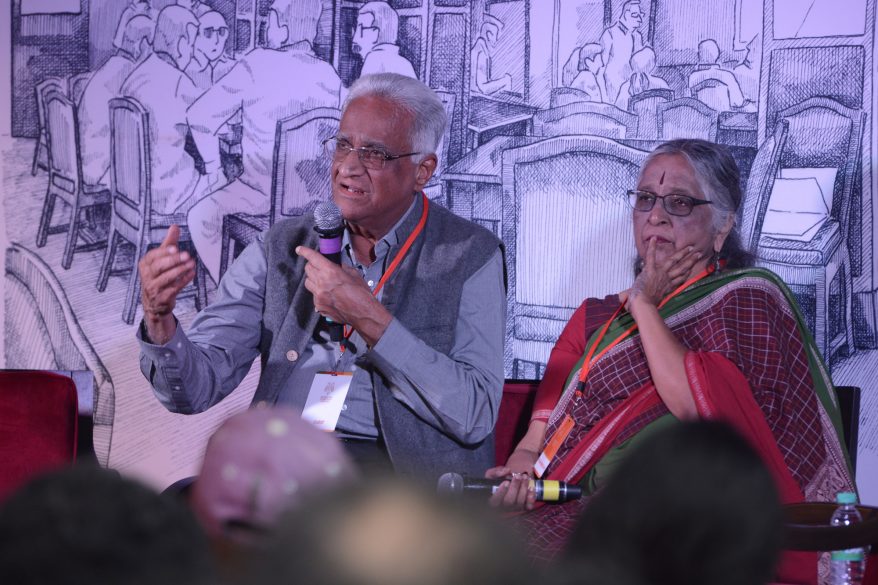
ISRO’s rise has been traced in the book by Gita and R Aravamudan. Mr Aravamudan was a handpicked engineer by Dr Vikram Sarabhai to work with India’s Space Program. His wife, Gita Aravamudan is an established journalist who has co-authored the book with her husband. He chuckles, the book was written by the two of them, where Gita did most of the writing and the content came in from him.

The session saw them trace the journey of ISRO from its humble beginning with just about 6 of them, taking up training from NASA, and setting up in the ionosphere of Trivandrum with the initial motivation to have sounding rockets launched with a few payloads. To fuel this, set up a station in Thumba. A few years into it, the technological revolution around the world had opened up the door for new technology in the communication front, and that was where Dr Sarabhai drew the idea of satellite vehicle building from.

The humble beginnings of ISRO which began with rockets like that of “Diwali crackers” has now taken intellectual minds over the years to build a mammoth of an organization today. He calls this a fantastic example of a Government run technical organization. This is the essence of the book, he says. With modest budgets, and with the laws of the Government, the employees were still motivated to do something for the organization. Gita recounts the experiments that included balloons that were sent up in the air in the initial days.

ISRO is an example of a single visionary’s guide to the establishment of it, with the full support from the Government while it was still establishing itself, Aravamudan says. It also had a clear agenda and transparency with which it operates. Its failures and successes were out in the open for all to see; the failures which were much mocked at.

His work alongside the late president Dr A.P.J Abdul Kalam, he calls from his memory fondly, and their successes with the Satellite Launch Vehicles, the hardships in procuring technology, and overcoming all of it is also etched in his memory. He remembers how they egged each other on, and that Satish Dhawan’s encouraging words brought in the much-needed inspiration. Till today, of the 40, 39 of the SLVs have been successful, a record in the making! Today, the Mangalyaan and Chandrayaan have been hugely successful even in its first attempt, he adds in excitedly.

Gita asks his opinion on the many comments and questions that come in from the public on the importance of investing in space programs when India is still grappling with very many economic issues. He draws a parallel, if a movie could cost 4 times more than the entire Mangalyaan project, it definitely answers the question. Moreover, being technologically dependent on other countries for critical technology such as GPS is a risk to the defence of the country. An investment in these programs will not only make India self-sufficient and cost-efficient but plays a huge role in governing our safety as well.

The book is one that definitely acknowledges the never say die spirit of the ISRO, a stunning example of a Government run organization that works like a well-oiled machine, only making the country proud with each passing year.


About the Author: A believer in the subtlety of magic in everyday living, and Shobhana seeks the same from the books she reads, and the poetry she writes. Immerses herself in music, literature, art, and looking out the window with some coffee. She curates her poetry, and occasional verses in her blog Thinking; inking. She currently writes for Bookstalkist.

Whose Lie is it Anyway: #Fakenews

The fact that even the Panchatantra and the Aesop’s Fables have a story about the shepherd boy who cried wolf when there was no wolf, underlines the fact that the phenomenon of fake news is not something ultra modern or a product of the internet age. However, to discuss the cry-wolves of our times, Nitin Pai, founder of Takshashila brought together personalities of contrasting backgrounds and competing tones for the last panel discussion at the Bangalore Literature Festival 2018. In attendance were award winning journalist best known for her Bofors investigation and editor-in-chief of thenewsminute.com – Chitra Subramaniam, Paris born journalist and author who has been South Asia correspondent for Le Figaro, one of France’s leading newspapers – François Gautier, Editor of The Hindu – Mukund Padmanabhan, Editor of scroll.in – Naresh Fernandes, Founder and Editor of AltNews – Pratik Sinha, and Sreenivasan Jain, Managing Editor of New Delhi Television (NDTV).

In order to set the context, Nitin asked each panelist about what defined fake news. Naresh opined with an example that while misinformation could be an error of judgement, disinformation with malice would count as fake news. Pratik of the AltNews gave the example of the Amritsar train tragedy wherein a fake narrative had been peddled about the driver’s religion to create social unrest and stressed upon the fact that fake news was affecting people of all ages, including children. Chitra joined the discussion and asserted that the phrase ‘fake news’ was an oxymoron and according to her there was only good journalism and then there was bad journalism. She also added that fake news happens when people with motives manufacture events and news.

Sreenivasan Jain kept the central government and the party in power at the centre at the centre of his attack and went on to say, “I believe that the only way to solve a problem is to first identify the problem. Fake news is not just lying in the dark corners of the internet but the central power itself plays a game of fake news by churning out propagandist theories and cherry picked data. These institutions, be it the government or the party in power have mainstreamed what was on the fringe.” He claimed that love jihad, scare mongering in the name of cows were part of this fake news propaganda. François, on the other hand, maintained that the word ‘fake news’ was too strong a word. Journalists have strong opinions and they pick stories and derive from them according to their opinions. He cited the example of the Nun rape case at Jhabua where mainstream media rushed to point fingers at the Hindu right wing groups but soon it was found that there were tribals and christians involved. François also cautioned people against the impulse of demonising the politicians because they were the the elected representatives in the country.

Nitin Pai further wanted the panel to explore the doors where fake news could be checked and threw the question to Naresh. Naresh mentioned that the government was trying to bring in some technological solutions to this menace but that wasn’t going to help. The session grew hotter by second and Sreenivasan provided a counter to François by saying that to criticize politician is not demonising him and to criticize the BJP doesn’t mean one is anti-Hindu. For him, the fake news machinery run by the government itself is the most dangerous one when compared to the fake news being peddled on whatsapp. Chitra had a contrarian point of view and asserted that she had lived through congress regimes and remembered how she and her family were harrassed with spread of falsehoods for ten years. She also claimed that while the word ‘fringe’ gets quoted a lot, the lot on the stage was the actual fringe which didn’t really understand India and how India thought. According to her, journalists must earn the right to be read like the politicians earn the right to lead.

François added his own perception of the Indian media and said that the Indian people did not have much respect for the the Indian media. Also, according to him, most of the media establishments have been left leaning in India. He underlined the importance of his views because he was born a catholic and unlike other people who parrot what they had heard from their older generations, he had learnt India first hand. Nitin went deeper into the subject and asked the panel if there were prejudices of people playing out as well. Pratik explained the importance of giving due attention to the fake news happening on whatsapp. “For rural areas, the influential people do affect opinions of the common people because they own smartphones and have access to internet and news”, added Pratik.

The session concluded with an attempt to fix the accountability question. Mukund agreed that Whatsapp was one of the major vectors for fake news and as such should not be ignored or downplayed. Also, not only does fake news affect the ignorant or gullible but also the intelligent and the informed lot. He maintained that the damage done by fake news was much worse than the redressal options like retraction etc.. Journalists and media houses must learn to apologize more often because there is no shame attached with it if one makes a mistake”, opined Mukund.

The session came to a close with a wide array of questions from the audience members and seemed to reinforce the idea of diversity in discourse which the Bangalore Literature Festival stands for.

How I Became a Hindu: My Discovery of Vedic Dharma

David Frawley spoke on ‘How I Became a Hindu: My Discovery of Vedic Dharma’ at the creatively named venue ‘Adjust Maadi’. Dr. David Frawley (Pandit Vamadeva Shastri) is a Vedic teacher and Hindu Acharya. He is the author of fifty books published in twenty languages worldwide. His fields of expertise include Yoga, Ayurveda, Vedanta, Jyotish and ancient Vedic texts. He has also written extensively on historical, social and cultural issues facing Hinduism and India today. Not to shy away from discussing contentious issues, Dr. Frawley began with describing his work of promoting vedic education, all paths of yoga, vedanta, jyotish, ayurveda, and other realms of the Indian system of knowledge under one umbrella of the Sanatana Dharma.

While stressing on the popularity of the Indian systems, he said – “India is not just a modern nation. India is millennia old vedic civilization that went inside the consciousness behind the universe. However, presently, modern India has lost its connection with its traditional systems.” He mentioned that there was no one Holy Book or one God or one Guru for the Hindus. There are more festivals, more Gods, more Gurus, more sampradayas, more books in the Indian system than in any other country or culture of the world. He added that the Indian festivals in particular should be regarded as World Heritage. He also pointed out that the courts in the United States did not interfere in the matter of religions and even the Indian courts did not do that in the matters of other religions. However, for Hindus, the courts and the state are controlling the religion from outside. Commenting later on the Sabarimala verdict of the Supreme Court, he asserted that when the courts and the state had no stake in the matters of religions and when they did not consult any of the Hindu Acharyas on such matters, they did not have the right to pronounce such a judgement.

David Frawley comes from a Catholic background and got interested in the Indian systems during the 60s movement, thanks to the Beatles, Maharishi Yogi, Prabhupada, Paramhansa Yogananda who he considers to be the Father of Yoga for the West. What he found lacking in the western philosophies, he found in Buddhism, Hinduism, and other eastern traditions. Gradually, he also studied Advaita Vedanta, Ramana Maharshi and Sri Sri Aurobindo’s works. He started correspondence with Anandamayi Ma and M.P. Pandit of the Sri Sri Aurobindo Ashram who later published his works in India. About 30 years ago, he was advised to become a Hindu and realizing he was already living the life of a Hindu, he adopted Hinduism. He continued his work on the ancient wisdom of India and was soon faced with ridicule for debunking the Aryan Invasion theory and showing Hinduism in positive light. Without naming the journalist of The Week magazine, Dr. Frawley informed the audience that the hatred amounted to him being labeled as a well known fascist. However, defending his position, he added that for the issues he had stood for in the United States, he had often been labeled as a leftist.

Dr. Frawley also expressed his bewilderment over the love Indians gave to Freud and Marx. According to him, all of Freud and Marx could be contained in a small corner of Aurobindo’s or Adi Shankara’s works. Dr. David Frawley appealed to the audience and the Hindus in general to become Sadhakas or practitioners instead of becoming academics in their traditional systems. “The Hindu wisdom is universal in nature and as such is relevant to everyone. The great knowledge of ‘I’m neither this body nor this mind’ comes from the Vedanta and the exposition of this thought must come from the inner practitioners and not the academics. Hindus must assert themselves because others are doing it already. They should understand and practise their wisdom and spread it to the whole world.”, he added.

Dr. David Frawley believes that India can only rise as India or Bharat and not by some imposed idea from outside. Q&A followed his concluding remarks where he answered questions on inner spiritual growth for the urban youth. He took up other subjects as well and impressed upon his audience that the idea that one can only be a born Hindu and not a convert was a propaganda, and the courts shouldn’t have intervened in the Sabarimala issue.


PaperPlanes#17 – Unearthing Bowl of Rice

हमर कतका सुन्दर गाँव
जइसे लछिमी जी के पाँव …..
अंगन मा तुलसी चौरा
कोठा मा बइला गरुवा
लखठा मा कोला बारी…..
जेकर लकठा मा हवे मदरसा
जहां नित कुटे नित खाए।
            -Pyaarelal Gupt

(My village so beautiful, like the feet of goddess Lakshmi. There’s a Tulsi in the courtyard and a buffalo in the porch, there’s also a garden full of greens. There’s also a place of learning near, where daily you eat and you beat.)

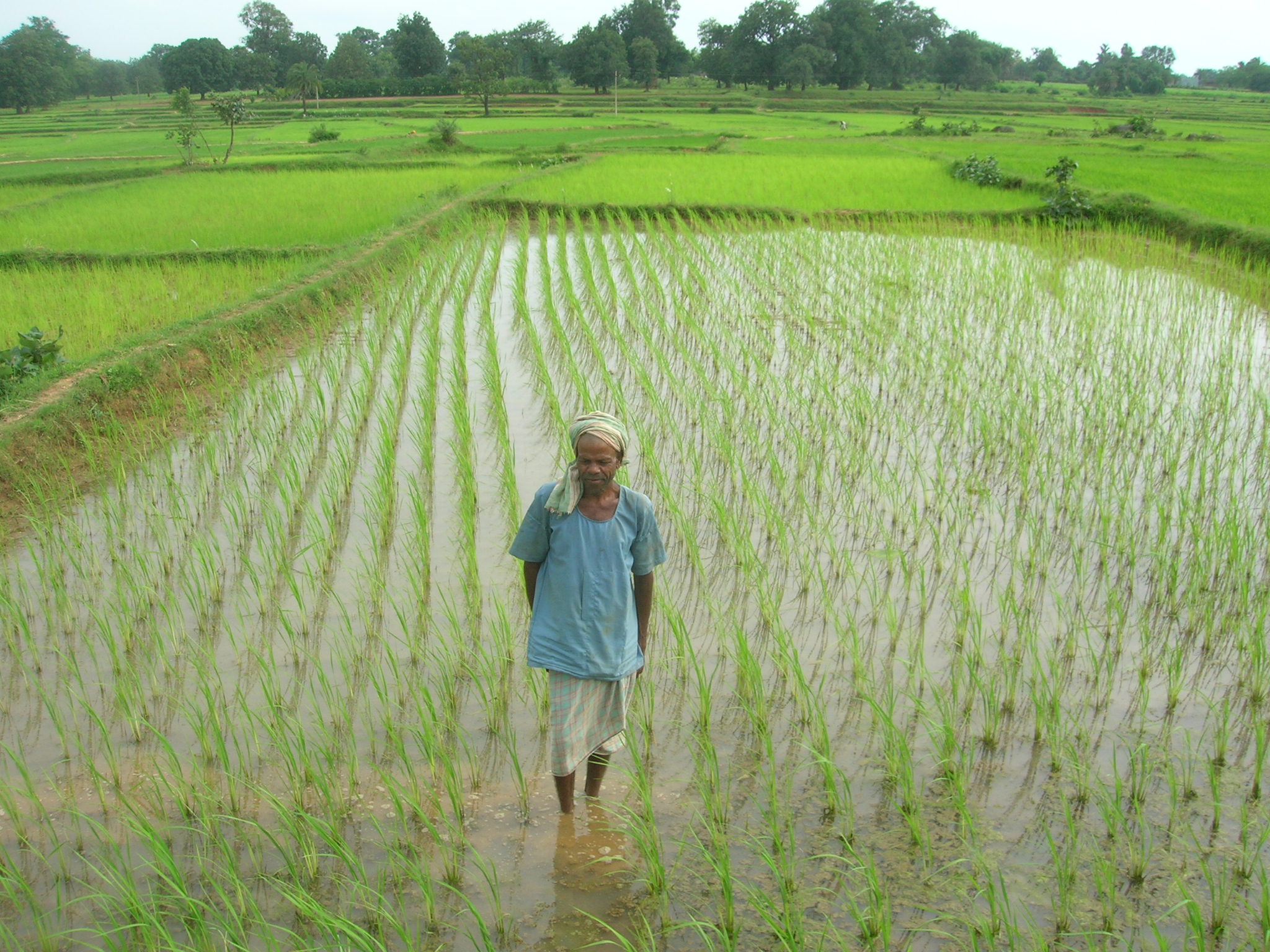
This poem is called Hamar Katka Sunder Gaav (My so beautiful village), written by one of the progressive poets of Chhattisgarhi Literature. This poem has beautifully captured the underdog literature of Chhattisgarh. This has been a predominantly agrarian state with small holdings farmer everywhere. This society was never a market-based society. It was sustainable, it had no waste and the soil flourished like gold. This poem is also capturing this village India, where home is in the soil. The place you learn is where you have to beat paddy to get rice at the same time, you get beaten to eat well the food of knowledge and learning. In Chhattisgarhi, the word for wealth is Dhan and the word for paddy is Dhaan. These words are not coincidentally similar rather people here value paddy as much as one values gold. Rice is called the gold of soil and this emotion cannot be justly expressed in English. Another masterpiece by a poet called Lakshman Masturiya goes:

मय छत्तीसगढ़िया अंव
मय छत्तीसगढ़िया अंव ग…..
सोन उगाथौं माटी खाथौं
मान ले देके हांसी पांथौं
खेती खार संग मोर मितानी
घाम-मयारू हितवा पानी……….
(I am a Chhattisgarhiya. I shoot gold, eat soil, I struggle to catch a laugh, field soil my company, sunlight my kindred, water by my side… )

This poem is self-explanatory but what is so beautiful and catching is the fact that the poet prides upon eating soil. He prides that water, soil, air are his friends and accomplice. It seems that he is complaining in the third line where he says that he hardly catches up on laughter but this is a sacrifice he made consciously to be friends with sunlight and water. Life in Chhattisgarh starts with agriculture and ends with the gold called harvested paddy. But one shouldn’t be in darkness and understand that because it is an agrarian society, it did not have the evils of caste, class, gender discrimination. Like Ambedkar had always questioned the village republic, Masturiya is not also not considering village as a utopia rather he writes another poem called Mor Sang Chalaw Re (Walk along with me):

मोर संग चलव रे ,मोर संग चलव जी
वो गिरे थके हपटे मन अउ परे डरे मनखे मन
मोर संग चलव रे ,मोर संग चलव ग…….
नवा जोत लव नवा गांव बर, रस्ता नवा गढव रे
मैं लहरी अंव मोर लहर मं फरव फुलव हारियावव
महानदी मैं अरपा-पैरी तन मन धो फरियालव
कहां जाहू बड़ दूर हे गंगा पापी इहे तरव रे………

(Walk along with me, walk along with me, those fallen, tired, scared souls of the heart, walk along with me, walk along with me! To new life,new village and to build new tracks, I am a free wave, you too join my wave and cleanse yourself. I am like Mahanadi and her sisters, wash away your body, your heart. Too far flows Ganga, I pour all my sins here.)

This poem is for a camaraderie. It calls to all those deprived sections of the society, who needs help in their upliftment. It calls them and asks them to join as if the author is not a person but a wave, an ideology. His ideology is to free one and all from the evils of the society.This will create a new village, a new path, a path free of sins. He compares this with the ritual of washing away sins in Ganga among Hindus. He says Ganga is too far, so immerse yourself in my Mahanadi!

Chhattisgarhi literature has never been read and circulated extensively. It has never come out of the state itself. In this amateur attempt of bringing more poems to the world, I have tried to show how literature has been diverse and some diversities are more equal than others.

In this attempt, I have used constant help from Sanjeev Tiwari Sir, a lone man in digitizing Chattisgarhi culture through the website www.gurturgoth.com .I express my gratitude toward this support and help.

About the Author: Kalpita Wadher is a Masters’ student of Social Science but her undergrad in literature makes her combine society and people with words of solace.

PaperPlanes#16 – Quest To Discover Self With Kamala Das Surayya

Search for identity has been the muse for many wordsmiths. The desperate need to define oneself and establish a sense of link somewhere, to someone had been informing the pages of literary compositions since ages. From Romanticism to Post- Colonialism, the time has been a witness to this struggle. This is especially pronounced in post-colonial literature, where the trauma of colonization gushed into creative narratives. In these, it is women, who were in double jeopardy on account of their gender along with post-colonial confusion, whose voices echo the loudest. Of these women, it is Kamala Das or ‘Madhavi Kutty’ as she is remembered fondly by some, who has carved a special place in Indian literature that can never belong to anyone else.

The first ever poem that I wrote was in my mother tongue Malayalam, titled ‘Pathimugam’. It was the consequence of assignment doled out by an ambitious teacher hoping to spur poets in our average, non-assuming 5th grade. Inventing words has always been a part of me since a time I am unable to trace back. Armed with the dictionary from my father’s half-eaten library, I set forth with my literary journey. That was my first tryst with poetry. The reason for this nostalgic journey is to pronounce the fact that I started out in my mother tongue, and gradually lost words in it when I began to consume more of English narratives. Being a brown-skinned Indian who now creates in English and not just translates, there were innumerable times I was shamed for my language preference. Language has been always been a medium to express feelings that pushed and prodded. Do I need a censorship there too?

I knew her as Kamala Das first. First through her anthology of poems ‘Summer In Calcutta’. Then through her autobiographical novel ‘My Story’, she was embraced as Madhavi Kutty. A fond voice that resonated with me. In the conservative, educated society of Kerala where I grew up, patriarchy is not so obvious as in other Indian states. It is masked and conveyed through culture or even excused under the grandiose of education. In that society, Kamala Das was a rebel. The modern day Robin Hood, who dared to take up arms and shatter the false-mirror of liberalism that Kerala wanted to project. She refused to let her voice be claimed too. She composed in English, raged in Malayalam and explored the one aspect of identity loss that she was experiencing: Language shaming. Why couldn’t she express in English when her words easily rhymed in it?

I read Kamala Das’s poem ‘Introduction’ much later, in the class of another genius Mrs Dennison. By then I had made acquaintance with Kamla Das and considered her mine. In the poem ‘Introduction’ Kamala Das voiced out and raged against the sense of identity that she had and the one people pushed onto her. This theme would go on to define much of this poetess’s life. A Malayali by birth, as E.M. Forster might describe her, she was English by tongue and Indian by the look. Her poem revealed her sense of struggle to conform. In the time when she found her voice, she was tormented by the constant reminder that English is an alien language which the post-colonial India should abandon. Even today Kerala, a home to intellectuals who continue to astound the whole Indian subcontinent with their English versification from Tharoor to Arundhati Roy, for the most part, remains hesitant to embrace the alienness of English that whole Indian subcontinent had invited to their very bedroom.

I don’t know politics but I know the names
Of those in power, and can repeat them like
Days of week, or names of months, beginning with Nehru.
I am Indian, very brown, born in Malabar,
I speak three languages, write in
Two, dream in one.
Don’t write in English, they said, English is
Not your mother-tongue. Why not leave
Me alone, critics, friends, visiting cousins,
Every one of you? Why not let me speak in
Any language I like? The language I speak,
Becomes mine, its distortions, its queernesses
All mine, mine alone.
It is half English, half Indian, funny perhaps, but it is honest,
It is as human as I am human, don’t
You see? It voices my joys, my longings, my
Hopes, and it is useful to me as cawing
Is to crows or roaring to the lions, it
Is human speech, the speech of the mind that is
Here and not there, a mind that sees and hears and
Is aware. Not the deaf, blind speech
Of trees in storm or of monsoon clouds or of rain or the
Incoherent mutterings of the blazing
Funeral pyre. I was child, and later they
Told me I grew, for I became tall, my limbs
Swelled and one or two places sprouted hair.
When I asked for love, not knowing what else to ask
For, he drew a youth of sixteen into the
Bedroom and closed the door, He did not beat me
But my sad woman-body felt so beaten.
The weight of my breasts and womb crushed me.
I shrank Pitifully.
Then … I wore a shirt and my
Brother’s trousers, cut my hair short and ignored
My womanliness. Dress in sarees, be girl
Be wife, they said. Be embroiderer, be cook,
Be a quarreller with servants. Fit in. Oh,
Belong, cried the categorizers. Don’t sit
On walls or peep in through our lace-draped windows.
Be Amy, or be Kamala. Or, better
Still, be Madhavikutty. It is time to
Choose a name, a role. Don’t play pretending games.
Don’t play at schizophrenia or be a
Nympho. Don’t cry embarrassingly loud when
Jilted in love … I met a man, loved him. Call
Him not by any name, he is every man
Who wants. a woman, just as I am every
Woman who seeks love. In him . . . the hungry haste
Of rivers, in me . . . the oceans’ tireless
Waiting. Who are you, I ask each and everyone,
The answer is, it is I. Anywhere and,
Everywhere, I see the one who calls himself I
In this world, he is tightly packed like the
Sword in its sheath. It is I who drink lonely
Drinks at twelve, midnight, in hotels of strange towns,
It is I who laugh, it is I who make love
And then, feel shame, it is I who lie dying
With a rattle in my throat. I am sinner,
I am saint. I am the beloved and the
Betrayed. I have no joys that are not yours, no
Aches which are not yours. I too call myself I.
(Introduction)

Discovering this poem is a feat that is one’s own. I can promise each of her lines like a dagger is sure to pierce your consciousness. And I will leave you to that journey. In conclusion, I would like to draw your notice to the feminist overtones in her poem. Ironically, Kamala Das has always refrained from defining herself as a feminist. Was it because she wanted her poetry to be much more than a crusade? We can only wonder!

About the Author : A wanderer at heart, Vibhuthi is the author of Rainbow, an anthology of poems that was published in 2009 by Nishaganti Publication.

PaperPlanes#15 – The Poetry of C

To grow a Texas cactus from the start,
You scatter tiny seeds on dirt and sand
(Your nail works well to nudge stuck ones apart).
Then sprinkle water with a steady hand.
Each day, my son asks, “Will it get real tall?”
He crowds his brother as they check for growth—
The way I’ve searched my hairless head since fall.
I pray young shoots will sprout up soon for both.
It happens all at once — soft spikes appear;
I rub my scalp while calling to the boys.
They peer in close to analyze each spear.
My bigger joy is lost to hooting noise.
The victory is all my own: Mom’s hair?
The news is that we grew a Prickly Pear.

Inspired by the cactus she brought from Texas for her sons to grow, Kyle Potvin wrote the poem ‘The New Normal’ about her experience with Cancer.

Poetry has two epicenters. One is located at a place where the poet has understood the world too well too quick. The second one is positioned where the poet is tired of trying and failing to comprehend the ways of this world. The question is – does it help? Is it capable of healing the wounds for good or does it just provide a momentary catharsis and the ancient suffering takes a modern form? What importance does a momentary catharsis play in a life that is being constantly seen by distant people with a sense of despair but a poetic hope by people on the inner arc? Does it make another day easier to live? Maybe it does. Otherwise, why would someone write this –

I come-to wearily, conscious of the slight ache in my shoulder.
I hold the kettle under the cold tap, one foot on the other on the chilly lino.

I watch the sheep from the kitchen window while I wait for the kettle to click off.
They are nibbling the hedge. I don’t know what attracts them. It looks bare to me.

I take my cereal and tea back to bed and arrange my two duvets, my hat and my scarf.
I am lucky to have an appetite.

Once I’ve drunk my tea I’ll have a cup of water then clean my teeth, have a salt-water rinse and try and chase some more sleep.

Despite it being a bright, sunny day out there, sometimes you just can’t find the will to live each day as if it were your last

(Chemo in winter/ Everyday life.)

Can poetry speak to the cells of cancer? When winds blow against the sails of today, can poetry, impregnated with our tomorrow, carry us through to the other side? Is cancer willing to understand what it means to be alive and why the human spirit never gives up its fight to breathe? Someday, can cancer realize that its host’s body is predisposed towards life? Can cancer be made to see how purposelessly it feeds on this world? In effecting all of these, can poetry play a role, a supporting one at the least?

I was pondering over the role of poetry in the fight against cancer. I looked around and I wasn’t alone!

I gaze at your face now,
Irish and watery eyed with fear and mirth.
There’s a line under your eye
that you didn’t have before…and soft red marks on your hands.

Prize fighter.
Fight dirty and grab it by its dark balls, or
if it happens to be a lady,
dig your nails in and pull out her hair. All’s fair.

(Prize fighter)

It does help that you can express your feelings about what you are going through. However, can a poet tell all that he feels? Did we ever have such a poet in the history of poetry? Language is too feeble a medium. That feeling which travels from your gut to the heart’s vessels to the canals of your brain and egresses out as saline something from the shores of your eyes can not be translated into any language. Do I wish that it could be? On days when a 17 year old boy knows all that is happening inside the body of his 37 year old mother, at least those unworded, shapeless emotions should be left to remain private.

What about the part that is voiced in a cancer poet’s words? For me, that expression is vital. A poet by his wont only exposes the portion that he understands can take the flights of expression and that right he has. He has the right to expose only the tip of the iceberg. A sensitive seagull can still perch on it and songs of hope can still be sung atop the numbing tip.

Passages to strength
Come in many forms and lengths,
Survival of the fittest,
The biggest
Lessons learned
Appear only when earned,
When fate turns
Its back on you,
Misconstrued,
Subdued
With questions of how and why,
Will I die?
How many tears am I able to cry?
The inquiries never seem to subside,
Outside,
I am a warrior-Braveheart if you will,
Yet within the walls of my ivory skin lies a disease that will kill
At will
With no prejudice or bias,
Ready to guide us
To our Maker of life

Where there lies no strife,
Maybe finally a day of peace
The heartaches will cease,
But my soul tells me to get up and fight
It is not my time to go towards the light,
The flight
That is destined for me
Is to be
The leader of every community
To help them see
It is not about you or I – it is about we,
I will not be added to the list of the deceased

Time of death 12:43,
Any demon can be defeated
As long as in the Lord’s hands you are seated,

(sigh)

I AM HERE
And yet you have been gone for slightly over 2 years,
And it’s amazing how my smiles take the place of those tears,
I now hope…instead of fear
And I pray that my message to all is crystal clear,
I stared Cancer right in the face
Not with anger but with womanly grace
And told it to get the hell out of this place!!!!!

(Cancer Slayer, Sabrina Esposito, Vero Beach, Florida)

Sources –
https://well.blogs.nytimes.com/2008/07/02/the-poetry-of-cancer/
http://www.keep-healthy.com/poems-about-cancer/
http://www.cancernet.co.uk/poems.htm

PaperPlanes#12 – Let me sing you a little song

Sonetto, meaning little song had its birth in Italy at the hands of Giacomo da Lentini. It was not long before it entered English shores with Sir Thomas Wyatt and Henry Howard. As with all poetic forms, the time has twirled and nicked this form here and there. Traditionally dealing with the theme of love, sonnets offered poets or sonneteers as they are referred to in this case, a vehicle to carry, ruminate and find a resolution to their dilemmas. Continue reading “PaperPlanes#12 – Let me sing you a little song”

PaperPlanes#11 – It’s Poetry. Period.

Last year, I was in a village in Gujarat, trying to understand about menstrual hygiene among rural women. It was fascinating that the topic of menstruation brought a lot of laughter among them, Clearly, they were ashamed to talk about the hush topic which was apparently dirty and unhygienic. It didn’t matter that I was also a woman and went through the same cycle. Continue reading “PaperPlanes#11 – It’s Poetry. Period.”

PaperPlanes#10 – Adonaïs

Imagine a man whose list of admirers reads like this:

  • poets and writers of the order of Lord Byron, Leigh Hunt, Thomas Love Peacock, Mary Shelley, Keats, Robert Browning and Thomas Hardy
  • social activists, no less than Henry David Thoreau, Leo Tolstoy, Karl Marx, Mahatma Gandhi and Martin Luther King Jr,
  • intellectual giants on the scale of Oscar Wilde, George Bernard Shaw, Bertrand Russell, WB Yeats and Aldous Huxley

Continue reading “PaperPlanes#10 – Adonaïs”

PaperPlanes#9 – Poetry Has A Language, And It Doesn’t Have To Be Your Mother Tongue

It was a cloudy evening in namma Bengaluru on which Harper Perennial had hosted its tenth-anniversary event at the new Blossom Book Store on the Church Street. They had Vivek Shanbhag, Anita Nair, Volga and Jayanth Kaikini as their chief guests. They spoke about their books in regional languages that got translated into English by Harper Perennial.

Though the guests spoke about books, the focus was language. At one point, Kaikini said when he lived in Mumbai, at home he spoke Konkani, Marathi on the local bus and metro, English and Hindi at work, and came back home to write in Kannada. Kaikini, if you don’t know, is a writer, poet, and above all, one of the lyricists who brought meaningful lyrics in Kannada movies back from the brink of a shameful death. Though his mother tongue is Konkani, he writes in Kannada because it is close to his heart. He also said people can understand better if written in a language close to them. For most people, unlike himself, mother tongue is close to their heart. For which I told yes, just like people get more offended when someone abuses them in their mother tongue than in any other language. Yes, I had to make that analogy. Because you don’t choose language, but the language chooses you.

Kamala Surayya, a noted poetess, under her penname Kamala Das, wrote in An Introduction – ‘Don’t write in English, they said, English is not your mother-tongue. Why not leave me alone, critics, friends, visiting cousins, every one of you? Why not let me speak in any language I like? The language I speak, becomes mine, its distortions, its queernesses all mine, mine alone.’ She was right. Poetry is a form of literary work that doesn’t care about language in which it is written. The poet writes in the language in which he or she is comfortable. The reader chooses poems in languages he or she enjoys. Both don’t have to be the same.

What a poet tries to convey through the poem is best known to him or her. A reader can only analyse and interpret it to his or her best knowledge. It is not the same as reading a novel or a short story. Nobody can impose a poem on anybody. Because a poem is a whole story written in fewer words. Poetry is not for everyone; so wrong. Perhaps poetry in all languages is not for everyone. That means it is not enough if you know the language to enjoy the poem. You have to feel it. You will only feel the poem if it is close to your heart. That’s why teachers in school took more time to explain poems than stories in the textbooks to students. Again, the teacher would have explained what he or she interpreted and might have differed from what the student thought. That’s why most students feel poetry is boring. No, poetry is not boring. It is just that poetry is not in the right language for that student or person. Because poetry has a language, and it doesn’t have to be your mother tongue.