Skip to content

TheSeer

For The Mindful Individual

  • Book Reviews
  • Bookmarks
    • Literature
    • Culture
    • Sociopolitical
    • Others
  • Interviews
  • Events
    • Upcoming Events
    • Events Coverage
    • The Seer Events
      • Singularity – Creative Learning Camps for Children
      • VoiceDabba – An Online Public Speaking Workshop for Children
      • Bangalore Reading Club Meetings
    • Partnered Events
      • BLF 2020
      • BLF 2019
      • BLF 2018
      • BLF 2017
      • BPF 2018
  • Contests
    • Kids
      • Young Reviewer Contest for Children – Winners Announced
      • StoryBaaz – A Story Writing Contest for Kids
    • Winning Entries
  • Our Services

Category: Partnered Events

Aadhaar – Dystopia or Utopia

November 1, 2017November 1, 2017 TheSeer TeamLeave a comment

The title can be simplified to ask if Aadhaar is slavery or not but this is not how our moderator Charles Assisi decided to put the topic into discussion, he said that when Henry Ford created a motorcar, the pertinent question was ‘do you create a motorcar first or do you create roads first?’.

Mr.Jairam Ramesh, former Minister of Rural Development, answered directly and said that he was part of the team which initially conceptualised Aadhaar. It was basically used to establish one’s identity. This meant Aadhaar’s work was limited to only tell you who you were and not to tell you what benefits you were entitled to. It was a technological tool to help government cut out duplication but everything changed after 2014 (when BJP came into power) to which the moderator questioned his pro-aadhaar stand in 2009 and Jairam Ramesh explained it as a beginning and not as a solution to solve exclusion errors of government schemes. To quote him “I believed in a different Aadhaar which was Aadhaar 1.0’’.

Commenting on the technology behind Aadhaar, Mr.Arun Maira who was closely linked with the issue, initially said that Aadhaar is a fine technology and like any other technology, this too had its own loopholes and if one looks at the global picture everyone is facing the backlashes of technology. Privacy of data needs to be given its due importance and all the countries are suffering and trying to come up with regulations for it. Jairam Ramesh responded to this saying that in 2010, a bill came in the parliament which asked to govern the use of Aadhaar but it was rejected lock, stock, and barrel. Had this bill been into the picture then, much of the atrocities which are happening currently could have been avoided. Sanjay Jain, who was the Director of this program said about the  technology that it was very flexible when it was implemented. This meant any old person was exempted and given Aadhaar card if the person’s fingerprints are not identifiable. But as in India things get lost in translation from source to beneficiaries, this same happened for Aadhaar. Thus, this issue is not a conflict of purpose but of execution of multiple complex data.

Jairam Ramesh ended by presenting two oppositions to Aadhaar, the first was the larger exclusion done by Aadhaar and secondly the expansion of Aadhaar to large number of areas without consent. His advice then to those in power is to not oversell Aadhaar but rather try to take a precautionary approach to the matter. One can identify sitting in a minister’s session if there are theatrical bits involved. In this session, Ramesh tried to bring consensus against Aadhaar by voting through raising of hands.

About the Author – Kalpita is a Bachelor in English Literature. Her ultimate goal is to fulfill the romantic notion of changing the world for better and she is pursuing MA in Development from Azim Premji University, Bangalore. She currently writes for Bookstalkist.

Literary Fiction – An Endangered Species?

November 1, 2017May 16, 2019 TheSeer TeamLeave a comment

The evening session started with Italo Calvino’s words for classics ‘books that are treasured by the readers who loved it and also for the first first time readers, those books are classics.’ Imraan Coovadia asked about the relevance of classics to all the three writers who were from very different backgrounds –  one writer Lu Jingjie was from China whereas Rajorshi Chakraborti is an Indian writer living in New Zealand, and we had Ambai, a senior writer from Tamil Nadu.

Continue reading “Literary Fiction – An Endangered Species?” →

From Pitch to Page – The Story of ‘Buffering Love’

November 1, 2017 TheSeer TeamLeave a comment

Writing involves giving your all and in Issac’s case, a break from regular work to finish his collection of short stories- ‘Buffering Love’. Issac in conversation with RJ Shraddha brought out his journey from Pitch to Page! Continue reading “From Pitch to Page – The Story of ‘Buffering Love’” →

Saris or Pantsuits?

November 1, 2017November 1, 2017 TheSeer TeamLeave a comment

Saris or Pantsuits was a conversation between the author, Radhika Nathan, the writer of ‘The Mute Anklet’, and ‘A Time to Burnish’, and a behavioural science expert, Gayathri who loves studying the impact of perceptions on people.
Continue reading “Saris or Pantsuits?” →

Tailing Veerappan

November 1, 2017 JeevaNayagiLeave a comment

“Veerappan was a bloated figure. He was too blown up like a balloon and had to be punctured”, says Vijaykumar who was Chief of the Special Task Force (STF) that was behind the encounter of the dreaded bandit Veerappan during Operation Cocoon in 2004. Vijaykumar has written a book titled ‘Veerappan: Chasing the Brigand’ where he talks in detail about the hunt for Veerappan. Kanwaljit Deol, another IPS officer talks to Vijaykumar about the book and Operation Cocoon in a session titled, ‘Tailing Veerappan’. Continue reading “Tailing Veerappan” →

Quo Vadis Higher Education?

November 1, 2017 TheSeer TeamLeave a comment

Quo Vadis literally means “Where are you going?”. But where the current Indian higher education system is heading to, is something that concerns Pankaj Chandra – Vice Chancellor and Chairman at Ahmedabad University and Ex-director at IIMB.

On the second and final day of Bangalore Literature Festival, Pankaj Chandra along with S Raghunath – professor of Corporate Strategy and Policy at IIMB – explained the issues, and challenges in Indian higher education system and also threw some light on what could be the possible solutions or ways to obtain a system that can help students rise up to their potential.

Some might argue that it is the grass root level where we have work to do and that we have to improve the primary education system which actually shapes a child into the student that he or she becomes. Reflecting on this argument, Pankaj had a little story to tell.

A good 5 years ago, he and few of his students, went to a college to audit a vocational course in commerce. When they reached the college and went to the classroom, they saw that the teacher was teaching ‘fractions’ to 17-year-old students; students who have already done their 12th. The students said that they simply had forgotten how to. This incident worked as a catalyst for Pankaj, and he decided to put his efforts into redesigning and reshaping the Indian higher education system into a better one.

Pankaj is a believer of hands-on education. “Why can we not teach theory in a laboratory? Why can we not teach sociology in a more real-life situation where we get to understand several nuances of social relationships much better. Everything should be a nose in and hands out. Building something has to become fun because doing something is actual learning.” – says Pankaj.

In order to learn, students have to experiment more and to experiment more, students need to have more freedom, and this brings down the topic of – giving higher education institutes more freedom and autonomy.

We have to choose content and pedagogy over the volume of content, argues Pankaj. Studying more simply doesn’t translate into higher knowledge. Institutes need more autonomy to give students more practical exposure or engage students more with the subject. Until the regulatory framework is overhauled in a huge way or is completely abolished, the institutes cannot reform the process of teaching. Pankaj is convinced that deregulation of the institutes and handing them more freedom is the way forward.

A believer of the multi-disciplinary education system, Pankaj wants the higher education system to churn out citizens who can solve real-world problems. A student should be given the right to choose multiple disciplines which are related and the student has the potential to do well. Education is a continuous process and even when a student is out of a physical institute, he should embark on a path of lifelong learning.

Speaking of which, the author candidly finished his session saying that compared to online learning setups, real brick and mortar institutes can create the competitive environment in which a student can engage and learn from others. Away from the internet, there is a real world out there and to prepare ourselves for those real-world challenges, we need the best possible real institutes in our country.

About the Author: Soumik Seth is an avid follower of music, current affairs, stock market, economy, and filmography. He currently writes for Bookstalkist.

Lanka’s Princess, Vamp or Winner?

November 1, 2017 JeevaNayagiLeave a comment

“Without Shurpanakha, there would be no Ramayana, don’t you think?” asked Kavita Kane. “There wouldn’t have been a war if Shurpanakha hadn’t met Ram and Lakshman in the forest. She’s the main trigger of the entire series of events in Ramayana. Yet, there is so little we know about her!” lamented Kavitha.

The female novelist, who recreated the entire story of Ramayana keeping Shurpanakha as the main character and the focus of all the attention, attended the final day of Bangalore Literature Festival and shared some of her thoughts on the character as well as the book.

The author spoke about her purpose and motivation behind choosing Shurpanakha as the focal point of this epic. The author believes that, if we see Shurpanakha as a vamp then we would judge her in a negative way. “Why do we have to do that?” she asks. If we start seeing her as a victim, somebody who suffered from extreme physical violence, then the paradigm shifts in favour of her. When we change perspectives, Shurpanakha becomes an entirely different person.

Breaking the stereotype is the key, mentions Kavitha. We have a choice of not always imagining Shurpanakha as a negative character by simply justifying her motivations and subsequent actions. Attraction is a human phenomenon and we, as considerate people, can make way for that phenomenon and simply accept that Shurpanakha was attracted to Ram. There should not be anything so wrong, that her nose had to be cut-off. Of course, Lakshman cut her nose when she tried to attack Sita. But the author maintained that, though Shurpanakha did make a mistake, in reality, it is very common for any human to make such a mistake.

If the characters portrayed in mythology are shown with all of their traits and if all shades of their personalities are shown, then it is much easier to forgive Shurpanakha for what mistakes she had committed and the world as it is today – filled with eternal prejudice, bias and discrimination against a woman who had committed a simple human error – is something the author wishes to change.

Kavitha goes on to elaborate that, evil has no gender and no colour. Darkness cannot be stereotyped into evil and fairness cannot be stereotyped into the divine. In the same light, the mere name Shurpanakha should not be stereotyped into something pure evil. Breaking perceptions and getting rid of norms and stereotypes is all this book is about, said Kavitha.

The author went on to say that, even though Shurpanakha is a fictional character, we can still draw parallels with real life. But for the audience to believe in a work of fiction, the author cannot simply use her figment of imagination and create a character so different that the audience cannot relate to. The author indeed has to research and the portrayal of any fictional character is made, to a lot of extents, to fit the societal expectations of the reader. Balancing facts with fiction is the true challenge when it comes to writing mythology inspired novels, she concluded.

About the Author: Soumik Seth is an avid follower of music, current affairs, stock market, economy, and filmography. He currently writes for Bookstalkist.

Writing for Children – Contemporary Issues Vs Traditional Stories

November 1, 2017 TheSeer TeamLeave a comment

‘With every book I am pushing the line, thinking how much can I get away with’, said Ranjit Lal, an author who addresses even the not so pleasant topics in Children’s literature. Th session ‘Writing for Children’ saw two of our favourite authors on that genre having a cordial and warm discussion on the Children’s literature. Reena Puri and Ranjit Lal argued for traditional themes vs the contemporary themes in Children’s literature. The session seemed almost like storytelling episode. Their well-modulated voices and hand gestures might have reminded more than a few in the audience of their favourite English teachers.

Sudeshna Shome was the moderator of the session. She knew how to ask the questions that can elicit replies that might long live for the session. To all of you who thinks Children’s literature is not significant enough to discuss, let me remind you of the vocabulary, the morals, the adventure and imagination that only a book can give to a child. I will also add patience to the list as I have seen my little brother sit still only when he had a Balbhumi during his toddler days.

Ranjit Lal whose books are based on contemporary themes confessed how he can’t write on traditional themes as it is a field that he has zero knowledge on. Everyday concern and evils that children need to be educated on are taken up by Ranjit Lal. For instance, one of his books deals with grandchildren learning to cope up with their Grandfather’s amnesia. His books are also noted for the female/ girl centrism. In his book, it is always the girl who guides the boy. He admitted in the session with a grin that it might be the result of growing up between two sisters.

Reena Puri, editor of Amar Chitra Katha emphasised on traditional themes in Children’s literature. She spoke how myth and tradition are used to educate the children on their rich culture. Reena Puri also spoke of their collective attempts to tailor myths and tradition to the present needs in Children’s literature. The westernisation that has happened even in Children’s literature was something both the authors agreed on. Ranjit Lal recounted an incident when he was asked to judge a children’s short story competition. He found to his dismay that all their characters had names like Jack or Jill.

The session also saw Ranjit Lal explaining the absence of parent or adult figures in his stories. They interfere too much. I put them in a hospital or something, he replied to the audience and I am charmed.

About the Author: Vibhuthi Viswanathan is a Potterhead and chocoholic.Curling up with the ‘Balabhumi’ and spinning out tales from its illustrations to her little brother was her first interactions with a book. Although she has moved on from good old BalaBhumi, she still hasn’t stopped twirling words and pauses. She currently writes for Bookstalkist.
Nature and the City

November 1, 2017November 1, 2017 JeevaNayagiLeave a comment

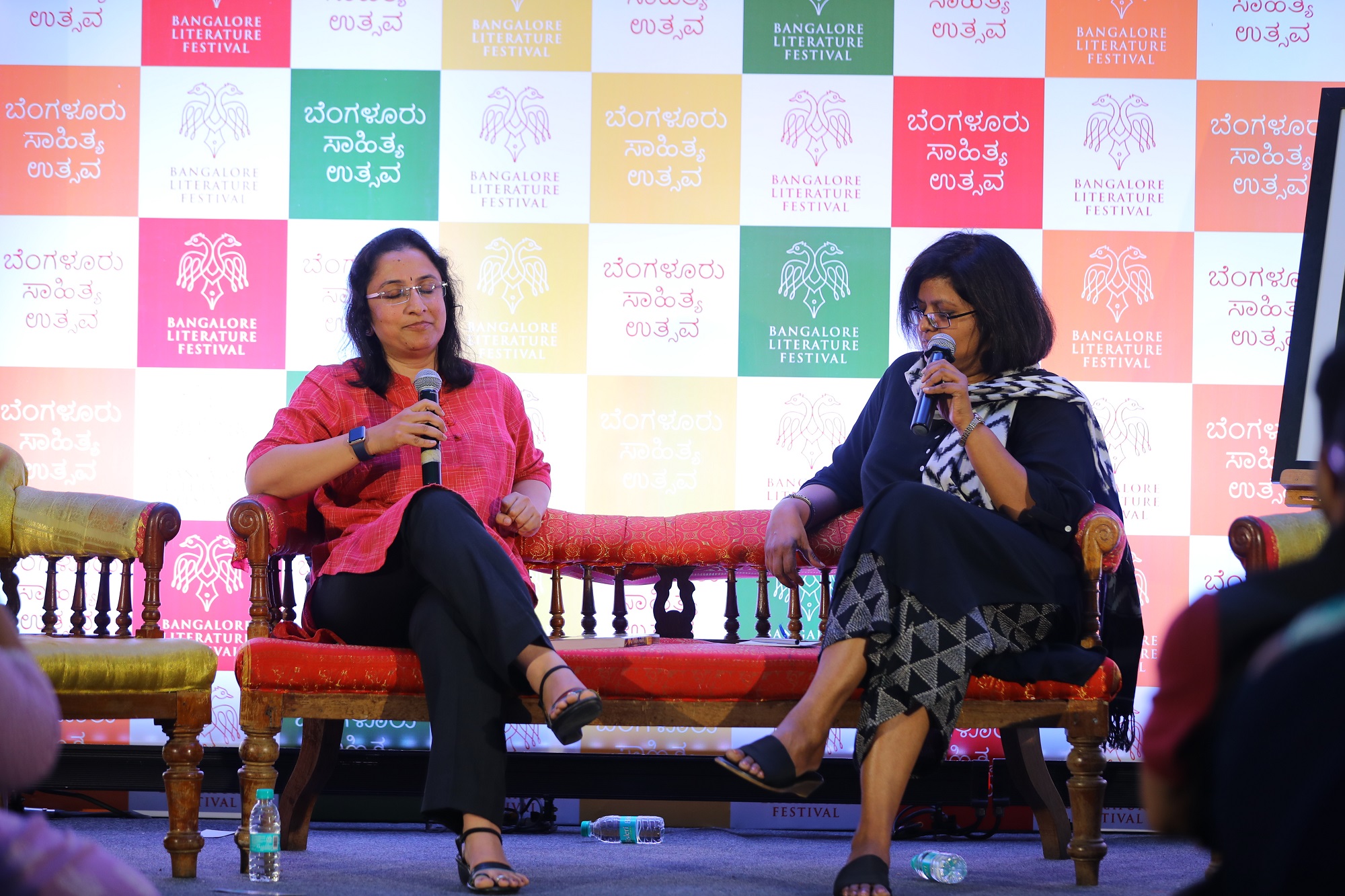
Journalist Dhanya Rajendran moderated a discussion with Jairam Ramesh, Member of Parliament and Harini Nagendra, Professor of Sustainability, Azim Premji University. The session was titled ‘Nature and the City ‘ and the discussion was focused around two books – Jairam’s ‘A life in Nature’ and Harini’s ‘Nature in the City: Bengaluru in the Past, Present, and Future’. Continue reading “Nature and the City” →

Border Tales

November 1, 2017 TheSeer TeamLeave a comment

When a national security expert, a journalist, and a feminist come together to discuss their perspectives on Borders, you can expect some uncensored truths. The session, ‘Border Tales’ saw Bishwanath Ghosh and General Kamal Davar putting across their perspectives on Borders. Ritu Menon was there to moderate the discussion and honestly, the word shuttle she played with Kamal Davar was the much-needed light in the discussion. Continue reading “Border Tales” →

India and China: How History is a Fickle Mistress

October 31, 2017October 31, 2017 JeevaNayagiLeave a comment

Author and Journalist, Raghu Karnad quotes journalist James Cameron as he sits down with India’s first woman Foreign Secretary Nirupama Menon Rao to discuss India and China. India and China: How History is a Fickle Mistress – the session could not be more aptly titled given the immense depth of the relationship between India and China. Continue reading “India and China: How History is a Fickle Mistress” →

Nationalism, Populism and the Threat to the Global Liberal Order

October 31, 2017October 31, 2017 Abhishek JhaLeave a comment

6pm on 29th October | 2nd Day of the Bangalore Literature Festival – connoisseurs of literature moved through different directions; some took the left, another set walked from the right, and a few had to take the centre (political correctness?). Notwithstanding the route wished, granted, or taken, the feet of democracy converged at ‘Speak Up’ venue of the Bangalore Literature Festival to register their attendance for the numero-uno on the  best-selling sessions list of the day titled ‘Nationalism, Populism and the Threat to the Global Liberal Order’.

Continue reading “Nationalism, Populism and the Threat to the Global Liberal Order” →

Posts navigation

Older posts
Newer posts

Become TheSeer Insider

Press Like to Stay Updated on Facebook

Press Like to Stay Updated on Facebook

Most Read Articles

  • The Absurdity We Live With: On the Meaninglessness of Life
    The Absurdity We Live With: On the Meaninglessness of Life
  • Condolence Message on the Mahasamadhi of Srimat Swami Shashankananda
    Condolence Message on the Mahasamadhi of Srimat Swami Shashankananda
  • Ichiro Kishimi, Fumitake Koga, and Oscar Trimboli Walk into My Library...
    Ichiro Kishimi, Fumitake Koga, and Oscar Trimboli Walk into My Library...
  • Why the Ayodhya Ram Mandir Represents a Collective Catharsis for the Indian Mind
    Why the Ayodhya Ram Mandir Represents a Collective Catharsis for the Indian Mind
  • Reverie Under the Bangalore Clouds
    Reverie Under the Bangalore Clouds
  • Why You Should’t Pixel(8) Your Life Any Further?
    Why You Should’t Pixel(8) Your Life Any Further?

Join Us

Enter your email address to subscribe and receive notifications of new articles by email.

  • Facebook
  • Twitter
  • Youtube
  • Instagram
  • About Us
  • In Media
  • Write With Us
  • Contact Us
Proudly powered by WordPress | Theme: Pena by Anariel Design.