The first time I read Svetlana Alexievich was when I chanced upon her Nobel Lecture. The lecture had excerpts from her books and writings. This was sometime in 2018 and until that moment, I had neither heard of her nor known that she was a Nobel laureate in literature. The stories from her Nobel Lecture were so powerful that I deliberately avoided reading anything about her as a person. The stories that she had to say were so important that I wanted to read them and I did not want to find out anything about her personality or politics that would stop me from reading her. Even though I did not rush to buy her books immediately, she and the stories from that lecture stayed with me for years. So many years later, on a random insignificant day I bought her first book , The Unwomanly face of War. Again, I didn’t rush to read it. Her stories waited for months on my bookshelf and finally last December, I picked it up to read.
A few pages into the book and I knew this was one of those books that would haunt me for the rest of my life. I believe it had waited for so long to find me, only so I could gather the courage to read through it. The people in her stories went through things that I wouldn’t wish even on fictional characters. However, these were real people, and these stories were too real to bear.
‘The Unwomanly face of War’ is an oral history of Russian women who lived, served, and survived the Second World war. A great number of books have been written on wars, its heroes and the supposed glory of the victory, but I have read nothing like this. Every page in this book screams that there is no glory in war whatever the men of the world would have you believe. Or, as one of them would put it ,“ Fair or unfair, it is still disgusting to kill”.
Imagine being a teenage girl clad in men’s clothes, hair cut short firing at boys just as young as they were or being pregnant and walking through a minefield, or leaving an infant with an older family member to go to the front to fight, praying that the baby survives the bombing. I still struggle to wrap my head around the fact that most of the women featured in this book were then girls aged between thirteen to twenty and they survived inhuman conditions at the battlefield only to come back to even more terrorising lives that were ahead of them. How devastating and defeated it must have felt, to sacrifice one’s youth, love, family to the idea of a motherland that ceased to exist a few years after the war.
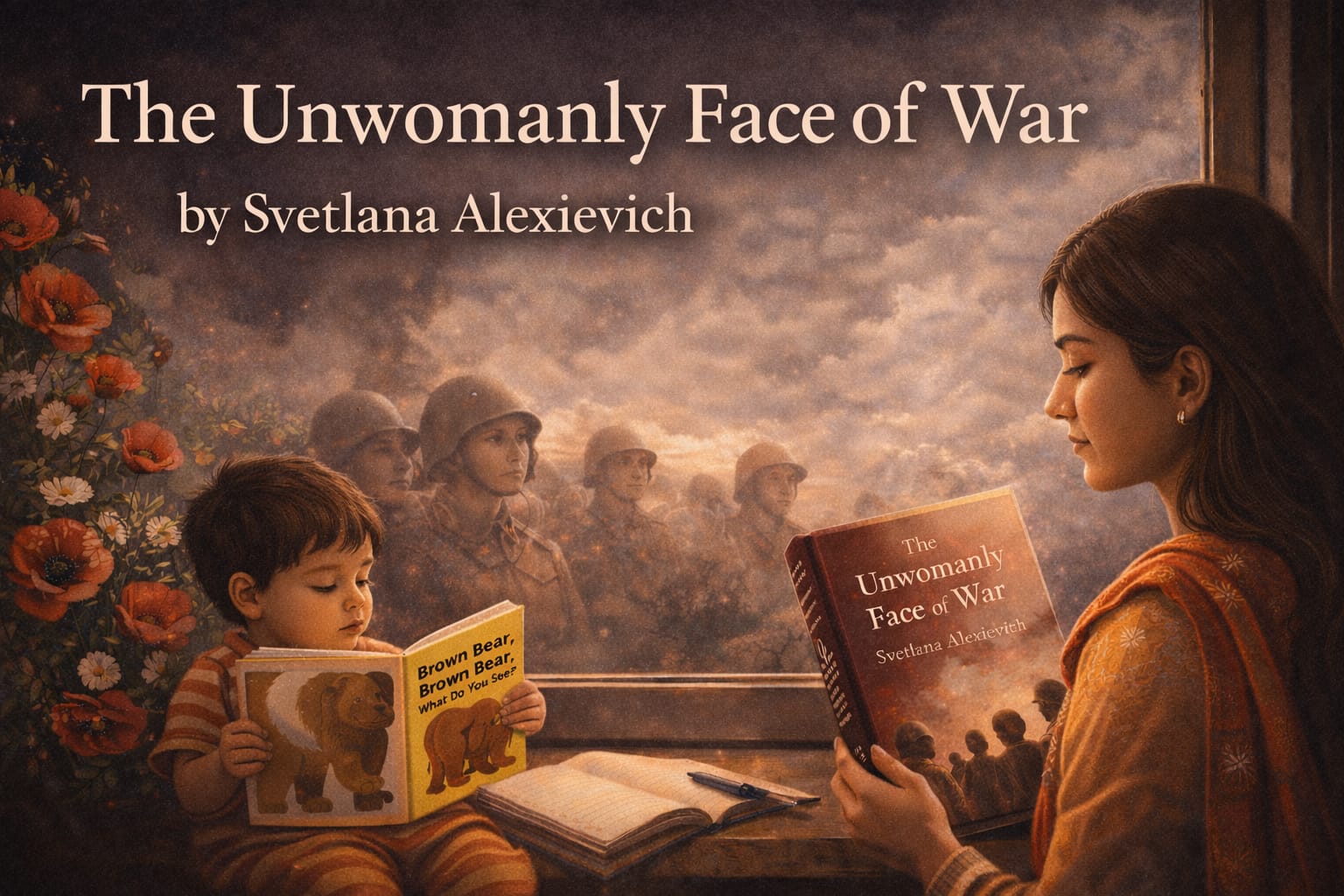
Reading the book made me realise how privileged my life is – how privileged most of our lives are. On some days while I read, my toddler would sit beside me with her book and sing “Brown bear , Brown bear, What do you see?”. That simple scene would instantly move me to tears. I think of all the mothers and their children, even the grown-up ones who live in conflict zones, and my heart goes out to them. It makes me want to hold my child closer and pray that there may be more peace in the world. As I pen this down, I see Svetlana’s next book “Last Witnesses – Unchildlike stories”, sitting on top of my table. I don’t think I have enough courage left to open it yet. I am going to let it sit there while I gather the strength to live through those harrowing experiences all over again.
I still know very little about Svetlana, her ideologies or what pushed her to document these stories. I do not know what she is up to these days. I do not intend to know until I have read more of her. However, my respect for her has only grown knowing the amount of time and effort that has gone into finding these women, prodding them, sitting patiently with their tears and fears and eventually shaping it into something this deep and stirring.
More power to her and may her ink never tremble.