In Conversation with a Neighbourhood Hero

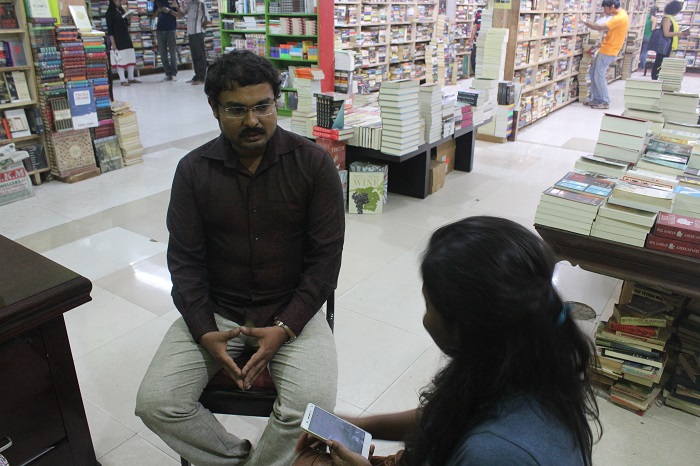
Have you ever wondered how mysterious the game of life is? How something nice happens to you out of nowhere making you feel all charged up and excited. It was a beautiful Sunday afternoon. As I walked through the Church Street of Bengaluru hunting for food, my legs stopped involuntarily in front of this beautiful place. It had a long inviting rack of books put up on display, a sight too tempting to not yield to especially if you are a BookStalkist. The name on the board  read “Bookworm”.

Continue reading “In Conversation with a Neighbourhood Hero”

Who is policing the Police?

It’s 15th August. Hum your favorite patriotic tune, speak about the achievements of the Government of the day, talk of pride in our culture and history, and proudly flaunt our progress as a society. Close your eyes and sleep. Happy Independence Day!

Or wake up! Look into the problems, discuss what is eating us from inside, find treatment for the termites of the system, struggle, fail, struggle again, fail, rise again, fight, bring a change! It’s 15th August. Justify the ‘Independence’ in that clichéd  ‘Happy Independence Day’!

You can skip this article if you would rather like to follow the first method. If you are ready for a long-drawn battle, read on.

Continue reading “Who is policing the Police?”

Nothing to write about!

And suddenly I have nothing to write about. A long night at work – I wanted to write about it – how tiring and hopeless situations you grow into at around 2.30 am in the morning typing in some code that you are no longer sure of. I wanted to write about that. I wanted to take a shot at poetry – dead of a night – smoky chilled air – rains – thunderstorms – trees wavering like tresses of the love I deserved – I might have jotted down the perfect poem for the moment. I wanted to write about my struggles. I would  have liked to finish my debut novel  in a one night’s shot. I wanted to write a tale – a disarming one or maybe even a spooky one that would leave me in despair by the end of it – perfect setting of a night and an under-construction would-be corporate building – cranes, dump-trucks, excavators all lying dead like there never was any life in them. I wanted to make new metaphors and similes- like a bulldozer’s night sleep  or lie like a windowpane!  Continue reading “Nothing to write about!”

Orwell on Gandhi

To judge somebody you haven’t ever met can be a daunting task. To judge somebody on the basis of what the person has done or written can be a miscarriage of fairness. Political heroes or villains are primarily judged in time by their actions in public view and their writings if available. This is to say for commentators who haven’t met the person. How your actions are judged depends largely on the media of the time as well.

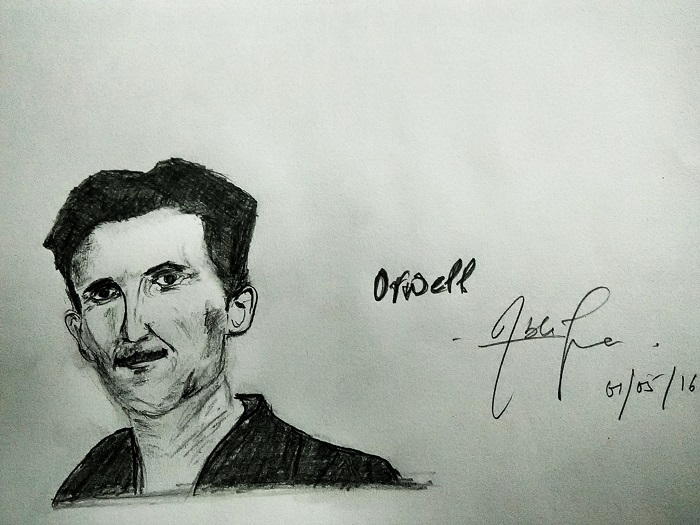
If I may, I would point you to the essay – ‘Reflections of Gandhi‘ by George Orwell. Why? Because his observations are as objective as they can get. In my opinion the essay stands out for a couple of things –

1. As the title suggests, the essay is indeed a reflection on Gandhi. The observations are so fluidly presented that it often feels like Orwell is talking to himself oblivious of our presence around him. He is not a great fan of Gandhi, neither is he a hater who can’t see beyond the aesthetics of the man. This puts him in a unique position.

2. Through his other essays, his hatred for any kind of imperialism is quite evident. However, since he knew the British ways too, he could look at Gandhi from the other side of the fence and was still in harmony with the dreams of free India that Gandhi nurtured.

George Orwell wrote his essay on Gandhi in 1949, a year after he was dead. He derives most of his ideas about the man – Gandhi from his autobiographical work My Experiments With Truthand other articles Mr Gandhi wrote for the press of the time. Mr. Orwell himself having lived a few years in the colonial Indian subcontinent, had a fair awareness of the situation back here. In addition, he was a prominent political observer and commentator of the time and hence must have judged Mr. Gandhi via his actions, interviews, and media interactions. What Mr. Orwell has written about Gandhi is of paramount importance and has been rightly placed at No 2 in the list of Greatest essays of Orwell as judged by Pulitzer prize winning writer Michael Hiltzik. The commentaries in our own country over Gandhi have been largely either biased highly in favor of the man or extremely against him. The Marxists and the so called Ambedkarites can’t contain their hatred for the man. The Indian National Congress though has nothing in common with the original Gandhi, is religiously exploiting the last name that they actually got from Mr. Feroze Ghandy (Do not get surprised here, many actually believe Mahatma Gandhi and present Gandhi scion are related.). If Mahatma Gandhi had the copyright to the surname Gandhi and had actually disallowed the usage of it, Mr. Rahul Gandhi would have been called Rahul Ghandy today and Mahatma Gandhi could have been spared some unfair posthumous embarrassment. The BJP has been trying to appropriate Mr. Gandhi in its own way and have been quite successful in leaving congress with nothing but shrill calls of ‘He-Is-Not-Yours’ and ‘You-Are-The-killers-Of-Gandhi’! This was not entirely unexpected given the predilection of the Congress party over the surname rather than the Gandhian way of life and politics. When you don’t feed your dog well, some day your neighbor will!

 

One important question that I have asked myself is whether the essay is prejudiced. Largely no, but there are enough signs of prejudices to be detected by any reader who has followed Orwell and his life for some time. Orwell’s own lifestyle has an effect on the essay and at times he digresses for the sake of satirical declarations that are hallmarks of his writings. However, such utterances are rare and the piece remains rational for the most part.

Orwell goes on to ponder upon the extent to which Gandhi was responsible for India’s freedom and counts many reasons that could have been responsible. He doesn’t give a judgement and says – “But if, by 1945, there had grown up in Britain a large body of opinion sympathetic to Indian independence, how far was this due to Gandhi’s personal influence? And if, as may happen, India and Britain finally settle down into a decent and friendly relationship, will this be partly because Gandhi, by keeping up his struggle obstinately and without hatred, disinfected the political air? That one even thinks of asking such questions indicates his stature.

Orwell would have celebrated his 113th year on 25th June had he been alive. His bio headline is perhaps a signature to the eccentricity of his life – Born in Motihari, Bihar and Died in London, United Kingdom. Mr. Orwell has been one of my favorite writers for some time now and Mahatma Gandhi will remain a Hero I shall admire all my life. Though they might stand diametrically opposite to each other on the clocks of life and lifestyle, both of them had their own fallacies. However what they achieved in one lifetime makes the fault-lines almost invisible. My only regret is that while I can read and decide what Orwell thought of Gandhi, I have no way of knowing what Gandhi thought of him. I wonder what took Mr. Orwell so long to write about Gandhi. Sometimes it needs a death to trigger those thoughts that we keep pushing to the next day. Sadly, Orwell didn’t live much longer either. He passed away in 1950. I would have wished him a few more happy years for his life on his birthday.

To be or Not to be a Victim

Long ago in a country called India, there lived a girl called Nirbhaya. She was gang-raped and left to die. Enraged by the brutality of the incident, her country-men rose up in multitude against her offenders. They held rallies and spoke fiercely to render her justice. And then there was silence. Few years later there was a girl called Jisha in the other corner of the country who met an equally merciless fate. They woke up again to demand justice for Nirbhaya and Jisha. Then again silence took over them. Caught up amidst these alternating periods of voices, noises and radio silences, the Nirbhayas and Jishas never found an ending to their stories, forget about a happy ending. Continue reading “To be or Not to be a Victim”

(Part 2) Books – The Used and the Abused!

There is one particular incident that must be recounted here to make my point. One day, since I alighted from the bus at a stop which wasn’t exactly mine, I had to saunter till my residence through a stretch of road that I wasn’t familiar with. The stretch was eerily dark and quiet. After walking for some distance, I saw a minuscule, thatched hut to my left, and a lady standing outside calling out.


It took me a few seconds to realize that she was inviting me to have her. I wasn’t sure if she would have taken a refusal well, so I paced up and stopped only after attaining a safe distance. I could see lamp posts getting larger and shops appearing in sight. There was a used-book store that was selling books at Rs. 100 and 200 per kg. I had heard of this concept before but hadn’t seen books getting sold this way. Initially glad to have found such a store, I was left disillusioned once I checked the books. Most of them were run-of-the-mill books that people should avoid reading if they care for developing good taste. The only bright spots were the books on technical subjects but considering their weight, the deal was not very sweet. I wasn’t exactly looking for technical books either.

I had to decline both the offers – that of the sex-worker and of the bookstore. From whatever I could see of them and comprehend, both appeared battered. Both were unkempt, abused, marked, and scarred. Both were ordinary.

So what goes into deciding the prices for sex trade in squalid belts of a city and old books stacked upon each other under a rugged tent-house? I ask this not because I have complete understanding of these trades. I just have a fair idea about the value of presentation. A procurer (pimp) adds glitters, polishes, and qualifies the services and the prices shoot up. Another procurer (publisher) does the same with a book. For some people, I might have crossed a few lines here but a procurer is not necessarily an evil person unless he is indeed an evil person regardless of whether he is a pimp or a publisher. Books that got published some 100 years ago are getting re-branded, re-edited, reprinted and resold at higher prices than the previous editions. Does the same happen with escorts? Till a point in their lives when age doesn’t start showing, it does. As they grow in the trade, the prices go up. However, flesh trade is not an exception. This is the norm in any industry. It’s an age when the quality of every product or service is measured against the benchmark of porn. #foodporn #bookgasm #foodgasm #wordporn  – any acquaintances in those hashtags there?

At a subconscious level, think of a sex-worker you have had, met or seen while going through the following lines.


What happens to the books that can no longer afford a publisher? They are sold like potatoes and onions in a last ditch attempt at making some money. What happens to the books that we buy and are long done with? What happens to the books that at least outwardly have nothing more to offer to us? I was not sincere when I had suggested to my friend that I would be selling them all. However, if one must sell, I think a second hand book should be sold at a higher price than the new one. In fact, the older a book gets, the higher its price should be, at least till the time it becomes really old and unreadable. It’s not very difficult to understand the reasons.

An old book, by the time reaches your hands has already enriched a few other lives before you and it has already gained some experience in changing lives. That experience, you do not have in a first edition first print. A freshman might make mistakes, a first copy might not give you what you expect of it, but in the case of an old one – more often than not, you are in safe hands because you have reached the book either of your hunting accord or after recommendations from someone you trust, and if you find a few scribbled notes in the book – you are perhaps luckier than many, and undoubtedly luckier than the first edition snobs.

Getting a glimpse into another life or going through a live commentary while you read those rusty pages is a priceless experience. Priceless things usually get sold at ambitiously steep prices. Hence, used books deserve better prices, abused books and you will find plenty of them – deserve our respect for having taken the blows of an untrained pretentious reader. In either case, I would choose to either go the capitalist way and sell them at higher prices than they were purchased or invoke my socialist side and give them away for free. The second option, would have to meet with great resistance from my faithfully capitalist enchantress bookshelf. The first one sounds more viable. I hope the world is ready when I sincerely mean to sell them. 

The essay  Books – The Used and the Abused! concludes with this part. Read the first part of the article here.

Books – The Used and the Abused!

Barely a minute after the gift books had reached the recipients, I got an email from Junglee, an Amazon subsidiary, saying something to the effect of – ‘Now that you have bought books from amazon, how about selling some on Junglee?’ Though this was a routine pitch, it got me into wondering about a lot of things of recent past. Just a day earlier I had told a friend in jest that I was going to sell all my books, take note – it was not a serious statement!

I don’t own a lot of things. My friends who know me well are completely sick of my wardrobe and at times have to take me hostage to get me to buy stuffs. This is not because I am on some money-saving mission, I don’t save either. So where does the money go? I don’t claim to have some sort of library for myself, but I have a respectable number of books with me and the number increases at a staggering rate. In fact, our Government could define BPL (Below Poverty Line) mark by just contrasting between my wardrobe and the bookshelf.  Rich gets richer, the poor gets poorer.

Capitalism-Socialism-Communism all sleep in the same bed here. I had read somewhere that the day you own more than single pair of clothes to cover yourself, you cease to be a communist. Now, most of the present day communists would certainly fail this test in today’s age and I don’t blame them. The condition itself is too stringent and suffocating. However, if for a few considerations, I am allowed to take it as the benchmark, then the beggar who just had a garbage box to comfort his spine in and almost no rag on his body,  just outside my workplace in Chennai would perhaps make the greatest Communist on earth. Marx and Lenin would miserably fail this test. Taking heart from this, my wardrobe stands a much better chance to be regarded as at least a reluctant communist, reluctant because perhaps it wants to get a few more clothes for itself, but its master is lazy as a dead bone in such matters. This opens up two new ways to become a communist –

1. Have a very bad master!
2. Become lazy, lazy like a dead bone.

Sitting on an antipodal citadel, my bookshelf is a shelf-ish enchantress. If there ever was a true capitalist, it is her. The master is possessed by her beauty and she makes him do all that she desires. When much of what the master earns goes into her wishes and fancies every month, it is not very difficult to understand how enslaved and smitten by her the master is!

There is no end to her desires. I have never left my bookshelf alone, but perhaps on one occasion when I was moving to a new city and all her possessions had to be transported beforehand. For about a month, I couldn’t see her due to delays in courier service. That was the only time we were separated. A thing to note here is that this Capitalist monster owns a lot of anti-communism books, and since sits just beside my reluctantly communist wardrobe, leaves no opportunity to jeer at him and show him how communism failed the day master’s friends bought him a second pair of clothes. I can’t tell you any method here to become a capitalist. It can’t be done. Capitalize is a verb, but capitalism is a noun. So, you might think you can capitalize to become a Capitalist but Capitalize in turn depends on some noun, say in this case – situation! That situation comes by itself, you just have to be greedy enough. Like I said, the day you work your ass off for another pair of clothes in your wardrobe, you have embarked yourself onto the voyage of Capitalism.

To let myself wander for some more time, I would want to touch upon capitalism in books-industry and what’s going wrong there. I remember my boyhood days when books containing spiritual or religious messages used to be distributed for free and if I talk particularly about a few organizations, they used to encourage their first readers to pass on the books to somebody who hadn’t read them and continue the relay so that someday in distant future, entire planet would know about these organizations. Backed up by huge grants and charity money, this was their way of marketing. To be candid about it, I used to collect all of them just to sniff the fresh-from-print pages. Not that I didn’t try reading them but failed to make any sense of the content matter then. Interestingly, many customers stood benefited as even if they never opened these books, never turned over a single page; they could always keep them on their study tables and shelves to show off.

This still continues with the Quran and the Bible. You get them for free most of the times and the people who throng on the stores to get these books for free, generally don’t belong to Islam or Christianity. However once they rack up these books in their house, it helps to prove their broad-mindedness and establish a secular image to their guests without having read a word. That notwithstanding, let us think from the perspective of an involved reader. For him, these socio-religious books still come at nominal costs. Additionally, most of the dedicated readers share these books on their own after having read them. While he can get a Bible or a Quran, or a Gita for almost nothing, Das Kapital will cost him somewhere between Rs 500 to Rs 1500 on Amazon.

The socio-religious book segment is more communist than the segment that sells the works of Karl Marx. Marx would perhaps say today – ‘Socio-religious book is the new opiate of the masses!’
Think of all the socio-religious books as public owned and the fact that anyone can read them easily, re-interpret, comment, criticize, and burn them amidst a few fatwas from selected communities – not very difficult to fathom! Unwittingly and ironically, the bible of communism can’t be bought by the segment of the society that needs to read it more than anyone else. They have to be content with mind-numbing tall tales of leaders and impostors, not that the leaders and impostors have much of a difference in today’s age.

The article continues in its second part.

She had that effect on me…

I was put in charge of hospitality committee and while preparing, since filtered water was available only in the teacher’s common room, had to drink untreated water many a times. This had distorted the texture and pitch of my voice temporarily. I love my voice, both literally and idiomatically. So it was a major setback. The croaky voice was intelligible only to me. Two days after the event was over, I was going to my classroom via the library corridor. She was walking towards the library and I was walking towards her. She waved her hand and helloed. I mumbled something that I don’t remember now. She asked me if I had drunk raw water from the supply taps. I had a silly smile on my face while nodding affirmatively. She smiled. That was magic, a surreal encounter of charm and power of beauty.

Continue reading “She had that effect on me…”

Portrait of an Amway Agent


Episode – 1

The air-conditioned buses that ply from Bengaluru city railway station are comfortable enough to get indulged in a bit of book reading. I had a book to finish –  Eminent Historians by Arun Shourie about which I have written in past. While I was immersed in my study, a soul who sat beside me called me out and inquired about the book. He must have been younger to me by 3 to 4 years.  Once I explained what the book was all about, he mentioned his whereabouts and his interest in history.

Continue reading “Portrait of an Amway Agent”

Can you see SriLanka from Kanyakumari ?

I come from a place very close to Kanyakumari. The beach is only about 10 kilometers away from my home” – Every time I tell someone about this, especially someone who isn’t from the southern part of the country, there is always a smile on their face accompanied by a glee in their eyes. I am very aware that the smile usually means “how amazing it must be to live near Kanyakumari”. Almost always this smile is followed with “Can you see Sri Lanka from Kanyakumari? “. Then it becomes my turn to smile. I had been an unsuspecting audience to a lot of conversations where newly-wed husbands on their honeymoon trip to the Cape Comorin explain to their new wives how the part of the sea behind the rock beside the shore where the water looks green is indeed the Arabian sea, the blue part the Indian ocean and the grey part, the Bay of Bengal. My smile turns into a grin when the Arabian Sea moves to east and Bay of Bengal shifts to the west.

Continue reading “Can you see SriLanka from Kanyakumari ?”

Love & Romance, Non-Fiction!

If dogs were to control this world, this world would be controlled by dogs. – Charles Dogwin

In his zeal to pack breakfast defying all odds, he had left his debit card at home. By the time he realized, it was too late to return and fetch it and since he didn’t know me then, I couldn’t come to help either. Not that I can help him now but don’t words of solidarity help? Though he had a sumptuous breakfast, he found himself cashless at lunch. He had made up his mind to go without eating and document the results of his experiment. He tried his luck one last time and checked his bag for some cash and what did he find – a 50 rupees note! Quietly he quashed the experimenter inside him and wisely had his lunch. He seemed ready to appear on a TV debate against the mighty-righty Donald Trump to proclaim the real valuation of a 50 rupees note.

Continue reading “Love & Romance, Non-Fiction!”

Are we a forgiving species?

Scene – 1 : 2016 – India beats Pakistan on 27th February. While the match is largely remembered for Virat Kohli’s skillful 49 in a difficult situation, the true-blue fans of cricket also remember this match for a brilliant spell of blitzkrieg bowling by Mohammad Amir.

Scene – 2 : 2009 – One of the most successful captains ever for Indian cricket team – Mohammad Azharuddin gets elected as Member of Parliament from Moradabad.  Continue reading “Are we a forgiving species?”