BLF2020 | One Arranged Murder – Chetan Bhagat with Shrabonti Bagchi

This conversation on Chetan’s recent murder mystery started on a light banter between Chetan (who joined virtually from Delhi) and Shrabonti, who, Chetan remarked, has done too many interviews of him; he feels she is his therapist!


From Love Stories to Murder Mysteries

Shrabonti quizzed Chetan on the setting of his book and his transition to writing mysteries. Chetan started by saying that he wrote love stories for 12 years and is now moving into murder. His previous novel, ‘The Girl in Room 105’ was an initial part of the transition. This latest book, ‘One Arranged Murder’, is set in a Punjabi family about a murder that happens on the night of the ‘Karva Chauth’ festival.

How challenging is it to write a murder mystery?

Shrabonti added that alibis must be created, the murderer’s identity should not be given away till the end. Chetan responded that it is a different ballgame to write a good mystery, there is a lot of craft in it. He studies authors such as Agatha Christie and Alfred Hitchcock to get various techniques for use in his stories. To that, he adds in Indian flavors, since readers want to relate to the Indian middle-class context.

Chetan referred to a ‘nerd-like precision’ he aims to bring into his stories; his background in engineering and banking is helping here. Chetan revealed an interesting trivia – that he uses spreadsheets to write! This helps him bring in precise endings.

Shrabonti digged into why Chetan chose this festival as the setting for the murder. Chetan referred to a newspaper article he read about a lady at Gurgaon who was pushed to death from her roof on ‘Karva Chauth’. He also said that a beginning which makes us ask, “How did it even happen?”, “Why did it happen?” forms an amazing start to the story. It sets the stage for an intriguing murder plot.

The ex-banker revealed that he brings in a number into each book title – e.g. ‘2 States’, ‘Revolution 2020’. He considered having ‘Chauth’ (the 4th day of the moon) in this title, however dropped the idea since this festival is not celebrated in all parts of India.

Shrabonti spoke about how protective Indian families are; which makes a family member an unlikely murderer. Chetan replied that it is a façade. He referred to how people put up only happy and good pictures on Instagram; the not-good moments are hidden away.

Chetan added that he aims to give his readers insights into the Indian family system, not just a murder puzzle. Shrabonti commented on how people related his murder plot to Sushant’s case since the book was released around the same time as Sushant’s death.

Chetan clarified that he wrote the book last year; its launch got delayed due to Corona and it so happened that the book’s publicity period was in August when Sushant’s case was in the news. The case was so gripping that he was quizzed on it during every interview and every channel projected only those responses.

He opined that, given the right mystery, India can get gripped; hence he believes he made the right switch from romance to murder.

Shrabonti pondered on whether the obsession with unexplained death is manufactured by media.

Chetan referred to it as ‘drama’ and went to say that drama is what engages people. He expressed his concern that news channels often cross the line while looking for drama to compete for viewers’ attention; “this is dangerous for the country”, he added. He also questioned why viewers should look for drama in the news and said, “this is a reflection of who we are as people”.

His take on ‘Love Jihad’

Chetan said that the term, ‘Love Jihad’, is a terrible term, since currently, ‘Jihad’ is a term that one closely associates with terrorism. He questioned why it was finding resonance among people.

He went on to talk about conversions. He said that conversion should not be done under duress and said, “I don’t know if conversion is a great recipe for harmony”. Chetan stressed on the need to have a proper discussion on conversion between various religions instead of ultra-right or ultra-left debates.

Q&A

The first question from the audience was on his path to transition from romance to murder. Chetan responded that it was a big challenge; a murder plot needs a lot more structure to make the suspense satisfying. The second question dwelt on politics – “Should we discuss politics at home?”. Chetan quipped that WhatsApp groups are the worst place to discuss politics. He explained that most people get emotional and hurt in such conversations, hence it is not wise to discuss political topics on such a forum. He observed that the politicians of opposing parties do not fight; in fact, they wish each other on their birthdays!

About the Author: Usha Ramaswamy craves to get more creative in addition to being an avid reader, traveller, vlogger, marketer of events, mobile photographer. One day, she wants to write a book but for now, she pens her reflections at her blog, talks about her experiences in her YouTube channel Usha’s LENS and puts up photos on Instagram. She is also a software professional and a mother of two. She currently writes for TheSeer.

BLF2020 | Avasthe – Chandan Gowda, Deepa Ganesh and N Manu Chakravarthy with Indira Chandrasekhar

UR Ananthamurthy (URA) was a contemporary writer and critic in Kannada language. He is considered to be one of the pioneers of a new modernist school of writing called Navya. Ananthamurthy’s works have been translated into several Indian and European languages. His popular works include Prashne, Akasha Mattu Bekku, Samskara & Bharathipura. His work deals with the psychological aspects of people from different times and circumstances.

The session opened up with the discussion on URA’s popular book ‘Avasthe’ which relies heavily on his skills as a thinker and writer. Ananthamurthy explored the possibilities of socialism in post-independent India through the life of Krishnappa Gowda. Popular translator Chandan Gowda claims Avasthe as a critically important book.

Chandan is not only a translator, as an actor he acted in a TV serial Bharathipura representing the character Jagannatha which was written by URA in 1973. A Life in the World, a book of autobiographical interviews with Ananthamurthy was published a year ago. Chandan says Avasthe clearly indicates the political ideology of URA. Casteism is considered as the underlying aspect of this novel. It mainly speaks about the struggles with corruption of human values representing a character Krishnappa Gowda, who goes on to become a revolutionary leader among workers with his conscience. In Ananthamurthy’s work, life’s cruel contradictions, caste, poverty are intricately balanced.

“Ananthamurthy’s ‘Avasthe’ is not merely a political novel,” says Deepa Ganesh who worked in the translation of Avasthe from Kannada to English. Her book A Life in Three Octaves has been published by Three Essays. Her translation of UR Ananthamurthy’s short stories won the Sahitya Akademi award. She shared her thoughts on the richness of the book and social thinking of URA. Characters in Avasthe resemble many politicians in real life. It reflects the state of politics and the state of mind of the particular community. Ananthamurthy maps 30 years of post independent Indian in three novels.

Another panel member in the discussion Manu Chakravarthy who knew the pulse of Ananthamurthy’s writings revealed the integrity in his books Samskara, Bara, Bharathipura Avasthe etc. URA’s way of writing involves discussion with his students to craft the book. Among them, Avasthe is mainly focused on rural culture and builds a character that has integral sense even after 40 years of its release and continues to create impact on the society.

About the Author: Bharath Srivatsav is a student of Mechanical Engineering from Bangalore. He dreams of building a career in cinema and literature. Some of his hobbies are reading books, travelling places, and blogging about films. He currently writes for TheSeer.

Watch | TheSeer Interviews – Priyanka Pradhan | Author – Tales from the Himalayas

TheSeer team spoke with the author of ‘Tales from the Himalayas’, Priyanka Pradhan, who opened up on her journey as a writer, themes from her stories, the process of getting your first book published and much more. Watch.

Priyanka Pradhan in conversation with Jeevanayagi

Like what you just watched? Become TheSeer Insider. You will be receiving one letter from us every Friday to help you spend a more mindful day and make the best of your weekend. Enter your email id below and click on subscribe. We won’t spam you, ever!

The Color Purple: Understanding Alice Walker’s Womanism

Many African American women have preferred the term womanism to black feminism. The term is taken from the Southern black folk expression of mothers to female children “you acting womanish”. Womanish girls acted in outrageous, courageous, and wilful ways as opposed to frivolous, irresponsible, and ‘girlish’. Womanism is rooted in the black woman’s historical experience of racial and gender oppression and consciously set itself apart from the white feminist movement. The Color Purple read in this context is a powerful, womanist narrative of the personal development of Celie, an African American woman living in early twentieth century rural Georgia.

The 1982 novel is written as a collection of letters she wrote to God and later, to her sister Nettie through her teenage and adult years. This epistolary form has been used repeatedly in women’s writings owing to its subjective nature. These letters are Celie’s expression of the violence and abuse she is regularly subjected to, first by her father, then by her husband. Written through the sensibilities of a teenage girl, it is an honest and brutal rendition. It is a novel that has been praised for breaking the silence around domestic and sexual abuse by narrating the lives of women in all honesty. Simultaneously, it has been subjected to numerous protests from some African American church groups and male writers who disapproved of showing love between women and violence against women within their community. Such is the politics of the African American woman, their voices are attacked both by the white supremacists and men within their community.

The narrative goes beyond a documentation of discrimination, as Celie tells us her story she also grows and changes. Celie’s transformation happens with the support of other black women giving importance to the black women’s sense of community, an important idea within womanist theory. Her interactions with Sofia, her stepson Harpo’s wife, shape her. Sofia is absolutely different from Celie, she would never let Harpo beat her but fight back. Through her interaction with Shug Avery, Celie begins to explore her sexuality, Shug also protects her from her husband. They are both ‘womanish’ role models for Celies. They are also women Celie nurses and aids, forging relationships of mutual support. We see colored women supporting each-other throughout the novel, even women who are otherwise shown to be at odds with each other. The Color Purple is about Celie exploring her sexuality and gaining autonomy, not her seeking a conventional marriage. This makes The Color Purple markedly different from the earlier 18th century woman centred novels which ended with the protagonist’s marriage and wealth acquisition or death.

It is a beautifully imagined journey of emancipation. Celie is soon disillusioned by the white Christian God. That is when she decides to stop writing letters to God and write to Nettie instead. Shug says, “When I found out I thought God was white, and a man, I lost interest.”(175)

Celie and Shug together explore an answer from within their own culture. The lives of the natives still living in Africa are also explored through Nettie’s experiences and her own attempt to negotiate between the Christian and Olinka traditions. The novel itself is written in the Black English vernacular questioning the hegemony of the language spoken largely by whites.

Celie’s quest for self development is hindered by both sexism and racism. Later, she also discovers that she is marginalised from dominant society by her sexual preference. According to the premise of intersectionality, race, and gender oppression does not merely ‘add up’. The Combahee River Collective Statement of 1977 helps us locate The Color Purple within the Black feminist (and womanist) struggle. It declares that Black women’s ‘liberation is a necessity not as an adjunct to somebody else’s.’ The novel is about Celie’s individual experience but can be seen as establishing the universality of a female and racial quest for selfhood. To read Alice Walker’s work outside this political context would be a gross act of unseeing. It is a novel that documents pain and suffering and yet it is essentially an optimistic work. There is the possibility of overcoming barriers, emancipation and even reconciliation. However, a positive ending does not mean an end to the conflict that drives the novel. The power structures of race, class, and gender are still in place. Would we say then that it is a book giving us a false sense of hope? Maybe, but being a part of Celie’s journey of emancipation sensitizes the reader. The novel engages in a transformation of the reader as the protagonist transforms. This power to move its reader is the revolutionary potential of The Color Purple. That is what makes it, in Peter S. Prescott’s words “A novel of permanent importance.”

Reference: WHAT’S IN A NAME? Womanism, Black Feminism, and Beyond by Patricia Hill Collins

Like what you just read? Become TheSeer Insider. You will be receiving one letter from us every Friday to help you spend a more mindful day and make the best of your weekend. Enter your email id below and click on subscribe. We won’t spam you, ever!

BLF2020 | Body and Soul – Vasudhendra with Rheea Mukherjee

The title ‘Body and Soul’ sets us off on our own accord of a journey of questioning and wondering about the entire interpretation of life and afterward. The writers present on stage, Vasudhendra and Rheea, have also had their share of conquest regarding the same and is reflective in their works.

Vasudhendra is a well-known Kannada author with more than 50 publications and 60+ awards to his credit. The publications include short stories, a collection of essays, novels, and translations. And Rheea Mukherjee is the author of The Body Myth and was shortlisted for the TATA Literature Live First Book Award 2019. Her work has been featured in the Los Angeles Times, BuzzFeed, Scroll.in, Electric Literature, Out of Print Magazine, and Southern Humanities Review among others.

Rheea started the conversation by admitting that she was quite confused about putting into words the body and soul and how to pull off an entire discussion on it! However, Vasudhendra came to her aid and presented his idea about body and soul with an analogy. It goes like this; he said that the soul is like the stones of a Hoysala temple that make up the entire temple. And just like the whole temple collapses when a single stone moves, the body is non-existent without the soul, is what he exclaims, to which Rheea agrees.

Vasudhendra further added that people will connect with friends and society when they have conversations beyond just a body’s structure. He gives an instance from his life. Community and the family questioned his body language and conduct because he was more on the feminine side. He said that it was instilled in him to like girls and walk in a masculine way. After years he realized it was so wrong to force the body in a way it does not want to behave. He addresses his body as another identity and says that it does not like to be subdued by the people’s norms. And that, people who love will always look beyond the body, that is, the soul.

To which, Rheea added that as a girl, she was always taught to cover her chest while stepping outside and she subconsciously carries the thought even now. She pointed out that just like a woman’s chest is objectified, many other things regarding the body are.

The conversation next steered towards the subject of freedom to express sexual desires. Vasudhendra points out a courtesan in Tanjore by the name of ‘Muddupalani.’ Muddupalani wrote a poem called ‘Radhika Santvana’ (in Telugu) where a woman’s sexual desires are expressed. This work was later republished and was banned for being vulgar during the British reign. Vasudhendra expressed his concern about how was expressing one’s desire vulgar? It’s just the needs of a person which is beautiful in its own way.

A lot of Vasudhendra’s work revolves around the LGBT community, and while he was writing his work, he found it extremely difficult to find English equivalent words in regional languages. Rheea wonders why is it so? Vasudhendra says that transgender people have been addressed in history because the community was aware that they existed. But gay/lesbian related words do not exist because society did not know their existence until two years from now! He admits to having used a term equivalent to ‘queer,’ which is not a very respectable one.

Rheea added to the point, saying that families work in a role-based way. Like, the husband is the provider, and the wife is the caretaker. Such predefined notions have made society very rigid and have assigned duties even before they realize their identity. These things have led us as a community to not see beyond the horizon.

They concluded on a note that nobody needs to change to fit in. And we can be anything when we step out of a certain mindset and set ourselves free. Vasudhendra quoted this as his concluding line of the conversation, “If I can understand Shakespeare, you can understand me as well.”

About the Author: Puja Ambalgekar is an IT employee who finds writing, reading, and books in general as an outer space experience. She believes that words have the power to make the difference you intend to. She likes writing poetry, mythology, and technology. You can find her here. She currently writes for TheSeer.

BLF2020 | The Last White Hunter – Joshua Mathew with Tony V Francis

This session was with Joshua Matthew, who penned down The Last White Hunter: Reminiscences of a Colonial Shikari, the biography of Donald Anderson, son of author and hunter Kenneth Anderson. Tony V Francis, a novelist and Media & Broadcasting professional with over 19 years of experience in the Indian Media industry, was very curious about knowing Joshua’s experiences throughout the journey of writing the book.

Joshua Matthew said the idea behind this book was to tell the extraordinary story of Donald and capture the changes in the jungles of South India and Bangalore during his lifetime. He wanted to shine a light on lesser-known aspects of Donald and the city’s past. He mentioned that all he had was Don’s story and his purpose was to tell it exactly the way it was, without any filters.

When Tony asked Joshua about his thought process when he started this project and how difficult it was for him to publish the book, Joshua talked about how he met Donald and accompanied him to his favourite jungles. He said he knew Don for 6 years, and during those years, Don gave him a fantastic collection of photographs and negatives starting from the late 1800s to the modern day. “I realized that nobody would be interested if I had just published the photographs. So I decided to tell his fascinating story and make the photographs a part of it.”, Joshua added. 

Speaking about the struggles of getting his book published, Joshua mentioned that the title and the story made it very challenging for him to find publishers. He said whenever he approached a publisher, it was always about the left and right way. The right side was about focusing on the right things like story and content. The left side was actually about building an audience for this book. So, he used to tell the publishers that if they would care about the publishing, he would take care of the selling. “The book took me 6 years because of Don’s health and other issues. So, I thought when the book was ready, I would already have an audience ready.” He added.

Later, the discussion revolved around Joshua sharing his experiences and conversations with Donald Anderson. He pointed out that his discussions with Don never really went in the way he wanted. He said he understood that a systematic or structured approach of asking questions and getting answers from Don wouldn’t work well. “It was difficult to get better insights from him before he got friendly with us. He wasn’t very open to talk and explain things. So we used to record his words secretly.” Joshua recalled.

Tony also shared some compelling lines from the forward of the book where T.N.A. Perumal, a wildlife photographer from Bangalore mentioned “Don and I are very similar. We are naturalists and the only difference was that I picked up a camera while he picked up a gun.” Joshua responded to this by quoting a few other words of Perumal where the latter once said whether it was hunting or photography, one had to understand and track the animals’ behaviour in the same way.

Towards the end, Tony emphasized the role of Aaya (Domestic help) who supported Don and mentioned that the stories she told were a big influence on his life. Joshua also talked about a few more interesting things about Don, and the colonial life in Bangalore during those times.

About the Author: Sai Pradeep is an aspiring writer from Visakhapatnam who recently published his first collection of poetry, All the Lights Within Us. He is working as a content writer in Bangalore. He currently writes for TheSeer.

BLF2020 | Mythology via Women – Madhavi S Mahadevan, Rashmi Terdal and Samhita Arni with Mani Rao

Mythology is long-lived, and its retelling is spread across in various formats, from poems to fictional novels. It’s the second day of the Bangalore Literature Festival 2020, and we had a panel of women writers who have written around mythical characters and stories.

Mani Rao, an author who featured in the Oxford Companion to Modern Poetry, was the moderator. In the panel, we had Madhavi; she’s a book critic and writer of children’s stories and short stories. She has written two books based on the characters of the Mahabharata. Next, we had Samhita Arni, known for her books ‘Sita’s Ramayana’ and ‘The Prince.’  Then we had Rashmi Terdal, journalist and writer, well known for her translation of ‘Uttara Kaanda’ by S. L. Bhyrappa.

Mani began the conversation by asking the ladies what led them towards writing around mythology and mythical characters.

Madhavi responded that she had heard the stories since her childhood, but it’s only now she realizes how bleak they are. She feels these tales not only need a retelling but a reinvention from a women’s perspective because the role of the women is undermined in the epics. She gives an instance from one of her books, the central character named Madhavi is a surrogate mother. And this story dates back to the Mahabharata times. It was an incident of commercial surrogacy, which is a huge business now.

Samhita shared her view that she had always heard mythical stories that glorify only men’s achievements. If we want to challenge our system for a change, both men and women should join hands and not just either of us. Thus, it is essential to bring forth victories and stories of women from the legacy to influence the future and current generations.

Rashmi said that the versions of the Ramayana and Mahabharata that she had read were abbreviated and subdued from a women’s perspective. The female voice is kept submissive and mellow, whereas the men’s heroics are glorified. These things drew her towards writing on the mythical stories from the perspective of the women characters.

Mani asked the panel if their being women influenced their writing and if it would be different for a male writer?

Madhavi said that her being a woman has definitely helped her get to know her book’s character, ‘Madhavi’ more precisely. Samhita said that she was subconsciously driven since she is a woman even though she never wanted her gender to be influential. Rashmi adds to her previous point that Ramayan has always been obsessed with the duties bestowed upon women. She gives an instance where king Dasharatha reminds Kaushalya of her priorities (husband, children, and kinsmen). Then she jumps to another example where Sita leaves the Dharma-Sabha where her exile’s decision took place. Ram was disturbed after Sita left and expressed his concern to his minister, which is highlighted in the book ‘Uttara Kaanda’. She appreciates the writer for giving Sita the voice she deserved and that we need more such writing.

“A woman rejected by a man can cross oceans, but a man rejected by a woman cannot do anything.” – Ram’s words to his minister from the book ‘Uttara Kaanda.’

They concluded the session with a note that Sita was liberated when she left the Dharma-Sabha, and this is just one character from the mythology. There are great stories of women who rose above everything that needed to be told and written about.

About the Author: Puja Ambalgekar is an IT employee who finds writing, reading, and books in general as an outer space experience. She believes that words have the power to make the difference you intend to. She likes writing poetry, mythology, and technology. You can find her here. She currently writes for TheSeer.

5 Books Everyone Must Read to Understand Swami Vivekananda, His Work and Message | National Youth Day Special

Swami Vivekananda was born today i.e. 12th January in the year 1863. As he went on to become the extraordinary man the world knows now, he influenced several men and women, directly as well as indirectly in his lifetime and beyond. From Alasinga Perumal to Subhash Chandra Bose, we find for many great lives, the deep impression Swami Vivekananda left on them. His work and message inspired people from all walks of life, from Indian revolutionaries and key political figures in the struggle freedom struggle like Bagha Jatin, Mahatma Gandhi, Sri Aurobindo, Jawaharlal Nehru, Hemchandra Ghosh, Bal Gangadhar Tilak, C. Rajagopalachari to industrialists like Jamshetji Tata and John D. Rockefeller, philosophers and scholars like William James, John Henry Wright, S. Radhakrishnan.

Fortunately, for our generation and the generations to come, we have his literature that we can pore over ourselves to understand this phenomenon. His speeches, letters, poems, and writings are in print, in demand, and easily available for us to find out his message first hand. Apart from these, there are also hundreds of biographies, commentaries, and articles across magazines and internet. To help you create an easy To-Read list on Swami Vivekananda, we are presenting 5 books that you can read to go deeper into his philosophy and understand the man who was hailed as the ‘cyclonic monk’ by the western world and the ‘spiritual father of the modern nationalist movement ‘ by Subhash Chandra Bose.

Life of Swami Vivekananda – His Eastern & Western Disciples

Published by Advaita Ashrama, this book is one of the most authentic and exhaustive biographies of Swami Vivekananda with details that earlier biographies do not cover. The book is available in two volumes and is a required reading on the life of Swami Vivekananda. You can purchase both the volumes here.

The Life of Vivekananda and the Universal Gospel – Romain Rolland

This book is one of the very first biographies of Swami Vivekananda and was penned by the French Nobel Laureate Romain Rolland of the Jean-Christophe fame. A lucid account of Swamiji’s life told in beautiful prose makes this book a literary masterpiece and a joy to read. Buy here.

Swami Vivekananda: A Historical Review – R.C. Majumdar

This book by the great historian R.C. Majumdar takes a look at Swamiji’s life with a historical perspective. A great attempt to underline the siginifance of Swamiji’s life and message from the vantage point of history, this one deserves a place in your shelf if you want to understand how Swami Vivekananda influenced not only his time but also the future course of history. Buy here.

Josephine MacLeod and Vivekananda’s Mission – Linda Prugh

Although this book is a biography of Josephine MacLeod, also lovingly called Tantine by Swami Vivekananda, her life is invariably conjoined with Swami Vivekananda’s as she was one of his first friends in the west and helped his mission both in the US and India. This book is a treasure trove for people who are looking for accounts related to Swamiji’s life hitherto not well-known in popular culture. You can read a review here and order a copy of the book here.

The Master as I Saw Him – Sister Nivedita

Sister Nivedita, earlier known as Margaret Noble left her country and adopted India as her motherland on the clarion call of Swamiji. She went on to influence Indian politics, sciences, arts, and literature in a very short span of time and remains arguably the most well known disciples of Swami Vivekananda. This book contains Sister Nivedita’s writings on Swamiji and gives out siginificant insights into his life and message, as seen by Sister Nivedita. You can purchase the book here.

We hope you will like these books. If you have read more books on Swami Vivekananda or have more suggestions on book related to him, please write to us in the comments section.

Like what you just read? Become TheSeer Insider. You will be receiving one letter from us every Friday to help you spend a more mindful day and make the best of your weekend. Enter your email id below and click on subscribe. We won’t spam you, ever!

BLF2020 | Jeena Yahaan, Marna Yahaan – Padmavati Rao, MK Raghavendra and Vidyashankar N With Samantak Bhadra

This session felt like a cinematic experience! When the veterans of cinema come together a very insightful discussion ensues. Samantak opened the session with the question if over time Indian cinema was trying to glorify an ideal life to help the masses get out of the drudgery of life? While doing this does it compromise on the realities?

Padmavati Rao, a renowned actor and writer, quoted her personal experience of what Nazir Husain, a famous actor during Indian independence days, said. He said that art cinema is very good to talk about, but people do not want to see their lives on screen. Thus, we need to create cinema that entertains them. Nazir’s films Jewel Thief, Carvaan etc. depicted what people wanted. She said that she feels it was a matter of choice then, but might be a compromise today.

Vidyashankar N, the founder member of Bengaluru International Film Festival, brought about a very interesting comparison between politics and cinema. He said that while for all other countries, cinema acted as a tool for political propagation, for India that was never the case. He spoke about how Gandhi was very against Indian cinema from the onset. This gives a picture of why Indian cinema was not used as a tool for political discourses.

He also added that the purpose of Indian cinema is not art but to serve as a tool of evolution of the capitalist mode of market economists. He thought that cinema is a cultural expression rather than an artistic expression. He brought about an important observation about villains before and after the 70s. Before the 70s, they were the smugglers, feudal lords, underworld dons, who also got unintentionally legitimized over the years. After the 70s, it changed to politicians, bureaucrats, and executives, where the idea is not evil, but the villains are.

MK Raghavendra, a writer on culture and international cinema, had such amazing knowledge and anecdotes to share about innumerable movies of all times. His view was that Indian cinema cannot avoid politics. The common factor that binds the public is politics. The messaging might not be explicit, but it has ingrained general political messaging. He quoted an example of 1948 movie Anokhi Ada and compared the plot and characters to the then political scene, with Pandit Nehru, Sardar Patel and Gandhi. Another example of the movie Anmol Ghadi by Mehboob khan and explained the underlying message.

He said that always dominant politics is followed in all cinemas. He took examples of Duniya Na Mane and Queen movies, to bring his point on how women are celebrated for performing their celebrated role in society. He also quoted examples of movies like Deewar and Johny Mera Naam that depicted Indira Gandhi’s anti-western agenda.

Samantak then moved the discussion to the next key topic related to gender issues. He asked in women-centric films is it the perpetuation of stereotypes or is it the reality?

Vidyashankar’s view on this was that one must look at the common denominator to sell for the audience. Cultural expressions, including music, dialogues, relationships are used because they are received very well by audiences. Basic instincts like sexuality, violence etc., the dominant ideologies, sell more. By doing this, the moviemakers get the cinematic dividends they are looking for.

Padmavati’s take was that women have been portrayed as victims because that was reality. She quoted an example of the movie English Vinglish where the protagonist is patronized to do housework. She also confessed that movies like Thappad are bringing a change in this direction in small measures. But the challenge still is that a liberated feminine audience too will be tempted to take side with men. It is so ingrained in our DNA, that we don’t allow ourselves to think otherwise. She said that she feels that women are contributing in a constructive way, saying we all need to coexist. She continued with her view that over years access to art has become less. It has become spectatorship now, while earlier it was participative.

She strongly brought out the point that cinema has been a culture keeper and has kept alive folk.

Raghavendra said that Indian cinema is constructed like a fable and thus every film has a message, and every character has to have only one meaning. The victim is also one of the parts and is essentialized.  He said that if someone is perceived as a victim, then one cannot bear to see them rise. Based on the essence of being, the rich are always rich and the romantic are always romantic.

Vidyashankar shared his challenges on taking Indian cinema to International Festivals. He spoke about the notions that are internationally carried about Indian cinema which makes it difficult to take many good ones to that level until it is truly representational of universal cinema.

He also spoke about an important aspect of social and natural orders in context with gender issues depicted in films. He said that natural order is the dominant aspect, to do with people’s attitude, which is unfortunately not changing. This makes it difficult to make a film where natural order is questioned.

About the Author: Neha Agrawal carries a spirit of positivism and a smile that emanates from the heart and wants to reach out to the world. She dreams to make this world an inclusive one. She works as a strategic leader heading multiple areas like inclusion & diversity, corporate social responsibility and organization culture. She is a public speaker and an influencer. She loves travelling, especially to the mountains. She writes poetry under the handle #fursatkealfaaz on Instagram, enjoys reading and having conversations. She currently writes for TheSeer.

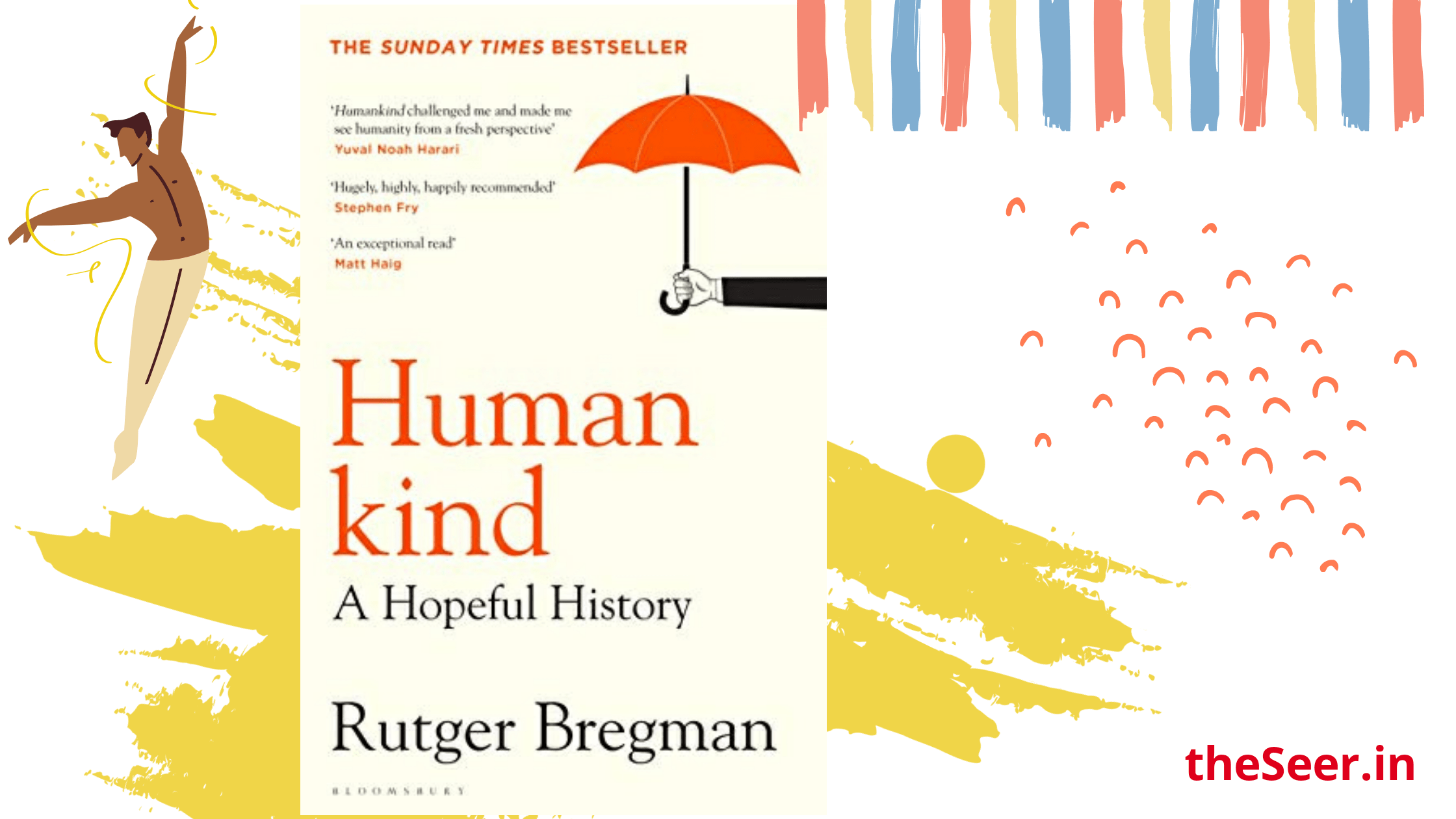
Rutger Bregman’s Humankind Amplifies the Voice of Hope in Human Nature

How many times have you come across a really disturbing piece of news or development where humans have indulged in the most inhumane acts possible and wondered if humans are after all terrible creatures who stay civilized only because they are regulated by law? How many times has someone tried to convince you that a law abiding citizen is abiding only because he has never got an opportunity to become a terrorist, that if the circumstances allowed, people would resort to their primal instincts and eat each other alive?

Remember the much celebrated movie – The Dark Knight? Joker puts his philosophy thus – “They need you right now, but when they don’t, they’ll cast you out, like a leper! You see, their morals, their code, it’s a bad joke. Dropped at the first sign of trouble. They’re only as good as the world allows them to be. I’ll show you. When the chips are down, these… these civilized people, they’ll eat each other...” Throughout the story, Joker is trying to establish that when humans get into the ‘Prisoner’s Dilemma’, they choose themselves over others. He devises a social experiment with the passengers of two boats – one has the civilians, other has the prisoners. He proclaims – “Tonight you’re all gonna be part of a social experiment. Through the magic of diesel fuel and ammonium nitrate, I’m ready right now to blow you all sky high. Anyone attempts to get off their boat, you all die. Each of you has a remote… to blow up the other boat. At midnight, I blow you all up. If, however, one of you presses the button, I’ll let that boat live. So, who’s it going to be: Harvey Dent’s most wanted scumbag collection, or the sweet and innocent civilians? You choose… oh, and you might want to decide quickly, because the people on the other boat might not be so noble.” How many times have you found yourself in agreement with Joker?

The Joker Meme

Recently, a Gangetic Dolphin was hacked to death by a group of men in Uttar Pradesh, India. It looked like they were killing for fun, out of a compulsive thirst to do something outrageous. Of course, such incidents make us want to believe in that seductive philosophy of Joker. A meme keeps roaming around in the social media space and must have at some point appeared on your timeline/inbox too.

What if I told you that several pioneering psychologists and scholars of our world would stand by Joker’s side when it came to the nature of human behaviour. Not only that, they also created different experiments to establish that humans are inherently evil. One of the most famous experimenters of the kind was Philip Zimbardo who is attributed for the Stanford Prison Experiment. Such experiments have been repeated in different time periods with minor modifications time and again by different people to theorize the same piece of ‘fact’ – that we are bad people! (Note: If you like watching Big Boss or other reality shows like Big Brother, you should read the book right away!)

In such a dark and depressing universe, what then remains of ‘Hope’? That and then some more are answered in Rutger Bregman’s 2020 book ‘Humankind: A Hopeful History‘. Bregman begins with the contrasting models of human behaviour propounded by Thomas Hobbes and Rousseau, and argues that we would be better off with the goodness of Rousseau than the cynicism of Hobbes. It is a difficult side to pick in a debate on human nature and that makes the book a riveting read from cover to cover. By the time I got done with the prologue, I had already put this book on my ‘few good things to come out of 2020’ list.

In order to bolster his argument, Bregman takes up the most famous episodes of human history and evaluates the conclusions drawn from each one of them. Some of the cases selected for investigation in the book are Stanford Prison Experiment, Death of Catherine Susan Genovese, Holocaust, and the novel Lord of the Flies by Nobel Prize-winning British author William Golding. Even though the author seems to have indulged reams of research papers on the matter, the book has been brilliantly composed to not overburden its readers with the routine of an academic journal. In fact, you will be surprised by the writing style, the tone of narration, and the impeccable transitions between themes. The book keeps you hooked on till its very last word.

A very touching tale unfolds in the chapter ‘When the Soldiers Came Out of the Trenches’ when the trenches on opposing sides celebrated Christmas together during the first world war. While the author draws several lessons from this episode, we as readers are given a reality check on how the social media, originally meant for connecting with people, use the same tool to judge, hurt, and stereotype people according to our prejudices. In this context, Bregman’s unconventional arguments on empathy & compassion shape the heart of the book around which all the remaining narratives flow.

It is tempting to like the Joker meme. However, I have never personally been a fan of such overarching generalization and could never bring myself up to like this theory that when the situation arises, we are going to eat each other. This was also the reason I could not convince myself to like the ending of an otherwise outstanding movie ‘Jallikattu’ which also happens to be India’s official entry to the 93rd Academy Awards. The ‘pessimistic’ view of reality sells like wildfire. In the video of the murder of this gangetic dolphin, even though I knew how it would end, I kept waiting for someone to stop the killers. And then I heard a voice in the video pleading with them not to kill. It sounded like hope. But like the men in the act, we have either ignored or silenced that voice at several turning points of our history. With Humankind, Rutger Bregman tries to amplify that voice to a decibel where it cannot be ignored or unheard anymore. I want to see him succeed.

Like what you just read? Become TheSeer Insider. You will be receiving one letter from us every Friday to help you spend a more mindful day and make the best of your weekend. Enter your email id below and click on subscribe. We won’t spam you, ever!

COVID-19, EPL, and the Evolution of Socially Conscious Advertising

Mesut Özil’s Tweet on Xinjiang 
Source: Mothership

Let’s solve water’… Like it’s a problem to be solved, which it is. The brilliance of the copywriting simplicity can be witnessed during the currently underway, English Premier League (EPL). In the aftermath of COVID-19 and necessary health and safety precautions, the uncertainties of potential revenues and absent audiences has the Premier League grappling with reworking the broadcast environment. Additionally, with the recent moratorium on unbridled advertising by the EPL’s advisory group, league clubs and associate brands have been given food for advertising thought. In June 2020, the “Premier League’s broadcast enhancement advisory group capped advertising at 25% of the branding at each club’s ground, with 65% reserved for images of fans and 10% for the Premier League’s imagery and logos.” Even as the EPL’s “500 million pound (USD 665 million) deal with PPTV” has been terminated due to acrimony over Mesut Özil taking on China about its Uighur Muslim camps, the global movement against discrimination and racism is expanding its influence in the golden game of advertising.

The Most-Watched Football League – English Premier League
Source: Project 11

Billion-Euro Covid Hit to Premiere League Revenue
Source: Deloitte & Bloomberg
Mesut Özil
Source: football.london

According to Deloitte’s Annual Review of Football Finance 2020’, “the Premier League continues to generate the highest revenues across the ‘big five’ of EUR 5.9 billion IN 2018-2019.” Considering COVID-19 has prompted the richest domestic soccer competition in the world to ask for “80% prepayment of broadcast rights fees,”  the EPL revenue is likely to be hit further after losing access to China’s 1.4 billion market. In early 2020, CSM Live was commissioned to print ‘stadium wraps’ for the expectedly empty stands of the club stadiums. Based on the advertising guidelines issued by the Premier League, club designs began veering towards positive brand associations such as Manchester United Against Racism.

No Room For Racism
Source: Sky Sports

While the No Room for Racism campaign was launched by the English Premier League in March 2019, furthering the efforts of the Kick It Out initiative against discrimination; the EPL’s history with racism and discrimination continues with the recent racial abuse directed at Crystal Palace’s Wilfred Zaha by a 12-year old from Solihull.

In response to the offender’s arrest, Zaha tweeted, “People need to understand that whatever your age, that your behaviour and your words come with consequences and you cannot hide behind social media…It is important social media platforms do as they did yesterday and seek out these individuals and remove them… It isn’t enough to just say #notoracism. We need action, we need education, things need to change.

According to Stop Funding Hate’s Alex Murray, “there’s the ability for football to come together to demand action. I think that the influence clubs have, as well as their massive spending power, means there’s a real opportunity to get behind a campaign like this and add to the impact it’s already having.” Even as campaigns such as Stop Funding Hate and ‘No Room for Racism’ promote initiatives against hate and discrimination, the Conscious Advertising Network is pressuring advertisers to be more conscious of branding associations. Launched in June 2019, the Conscious Advertising Network (CAN) was formed by co-founders Jake Dubbins and Harriet Kingaby as a response to media industry reports such as by The Times which demonstrated that big brands were inadvertently advertising next to content by extremists, pornographers, and white supremacists.’ According to Kingaby, “CAN feels strongly that all parts of the industry – brands, agencies, media owners, ad tech, regulators and civil society – should come together to fix the significant problems in the system… and now has over 70 members who are committed to ensuring industry ethics keeps pace with the technology of modern advertising.”

As the golden game of EPL advertising undergoes a makeover, one of the most loved and profitable exercises in global sporting collaboration will have to keep up with a more socially-conscious audience in its brand imagery as television/digital audiences worldwide stare at their screens for their favourite team’s next goal-making move.

Like what you just read? Become TheSeer Insider. You will be receiving one letter from us every Friday to help you spend a more mindful day and make the best of your weekend. Enter your email id below and click on subscribe. We won’t spam you, ever!

On Maps, Borders, and Nationality: Reading Amitav Ghosh’s The Shadow Lines

In writing The Shadow Lines, Amitav Ghosh has penned an eventful narrative of a young boy who stays in Calcutta and yet his world includes many parts of the globe. These are not places he has visited, but places he has read and heard about from his uncle Tridib and cousin Ila. One can easily relate to his longing for travel and his fascination with Ila’s luxurious life, who has moved across a number of foreign cities over the years. We learn of his family’s friendship with the English Price family, a bond born during the British Raj and spanning generations. We follow him as he visits London as an adult, meets the same people he met as a child, revisits the places he visited in Tridib’s stories and eventually gains an agonizing closure over a childhood trauma.

Beyond this personal story is a rich historical backdrop, we hear Tha’mma passionately recount her memories of the Swadeshi movement, we follow Tridib to London where he meets intellectuals during the Second World War and even explores a bomb site, the story of the Partition of British India is retold through the partition of Tha’mma’s childhood home, and the Communal riots of 1963-64 (Dhaka and Calcutta) are the setting for the novel’s climax. The Shadow Lines asks us to delve a bit deeper in history, understand how human lives have been affected, often tragically, by nationalist politics and the creation of borders.

Amitav Ghosh’s metaphorical retelling of the partition is a divided house, a recipe by two brothers to avoid constant quarrels that in reality creates a sense of bitterness and hostility. The children who cannot recollect what lives on the other side can only imagine what the other half of the house looks like. They conceive the people on the other side of the border to be completely different from theirs, when in reality they are not so different, being their extended family. A seemingly quirky section, it does more than add a touch of humour to the story, it tells us the story of nation formation as Ghosh sees it. As India became a country, Pakistan became its ‘other’, its complete opposite. For Ghosh, the differences between the people of the two countries is imagined, a result of the bitterness that partition has created.

The Shadow Lines explicitly defines the borders that mark territory as  artificial divisions created by politicians, calling them ‘shadow lines’, and implying that the nation itself is a social construct. The arbitrariness of borders is perhaps best conveyed in the journey undertaken by Tha’mma, the narrator’s grandmother, to bring her uncle, Jethamoshai, from Bangladesh to India. To Tha’mma, a Hindu man’s home is in India, but for Ghosh, the sense of belongingness, of having grown up somewhere creates ‘home’ and the Partition cannot change that. Travelling from Calcutta to Dhaka she expects to see a physical border between India and East Pakistan from the plane. To Amitav Ghosh, the drawing of borders on a political map cannot distance two nations that have a shared history and culture.  In fact, by showing different characters stuck in the same riot, the narrator in Calcutta and the others in Dhaka, The Shadow Lines gives us two cities, in two different countries that are as closely bound to each other as images in a mirror, one reflects the other.

The ‘shadow lines’ that divide people can be overcome, by understanding each other. The narrator is able to connect with England when Tridib tells him stories about his travels. When Tridib points out places in the Bartholomew’s Atlas, the young boy gets a chance to relive Tridib’s experiences. He creates detailed image-maps of these places he has never visited. So much so that when he arrives in London, he astonishes the others by his knowledge of the city’s geography. He looks for the places Tridib described, recollects the stories Tridib told. He is capable of finding Mrs. Price’s house without a map, owing to his memory of an A to Z street atlas of London that his father had brought him as a child. As Yusuf Mehdi says in his critical analysis of Ghosh’s book, the ‘shadow lines’ between nations can be surpassed only through emotional bonding between people.
We often tend to see the political as distant from the personal, Amitav Ghosh’s The Shadow Lines is a reminder that very real people are affected by what we read in the news. It has the potential to build sensitivity in its readers and offers a critique of the mainstream understanding of nationalism.

Like what you just read? Become TheSeer Insider. You will be receiving one letter from us every Friday to help you spend a more mindful day and make the best of your weekend. Enter your email id below and click on subscribe. We won’t spam you, ever!